Alejandro Lipschütz Friedmann
Chile's first National Prize for Sciences. He proved basic research could be done here, then spent thirty years dismantling the concept of race.
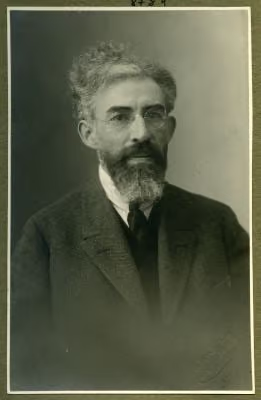
Heinrich Riedel (1870-1932), c. 1910-1920 · Dominio público
When Chile awarded the Premio Nacional de Ciencias for the first time in 1969, it went to a doctor born in Riga who had arrived in the country forty-three years earlier to become dean in Concepción.
By then Lipschütz had two complete scientific careers behind him: that of the physiologist who showed that basic research could be done in Chile, and that of the anthropologist who devoted three decades to dismantling the concept of race.
Riga, Berlin, Göttingen, Bern, Tartu
He was born on 20 August 1883 in Riga. He studied at the Nikolai I Gymnasium until 1901, entered the Faculty of Medicine at the University of Berlin in 1902, and earned his doctorate in Göttingen in 1907. He was a member of the Russian Social Democratic Labour Party from 1904, and left Russia after the 1905 crackdown.
He served as a military doctor in the Russian army during the First World War, taught at the University of Bern in 1915, and directed the Institute of Physiology at the University of Tartu, in Estonia, between 1919 and 1926. That year he was invited by Enrique Molina Garmendia, rector of the Universidad de Concepción, and Lipschütz crossed the Atlantic never to return.
Showing that it could be done here
He was dean of Medicine and director of the Institute of Physiology in Concepción between 1926 and 1937, where he also founded the Sociedad de Biología de Concepción. He then directed the Instituto de Medicina Experimental in Santiago until 1960 and was professor of Physiology at the Universidad de Chile. He was granted Chilean citizenship by an act of Congress in 1941.
His work in sexual endocrinology was pioneering, but what his colleagues singled out was not any one finding but something harder to measure: having proved, with original contributions and with disciples trained here, that basic research was possible in Chile.
basic research could be done in Chile
Héctor Croxatto, on what Lipschütz proved, translated from Spanish
Race as a social construct, in 1937
In 1937 he published Indoamericanismo y raza india (Indo-Americanism and the Indian Race), arguing that judgements of racial superiority and inferiority are social rather than biological, and have no factual basis. He wrote it while scientific racism in Europe was reaching its peak.
In 1946 he travelled to Tierra del Fuego and Patagonia to study the Fuegian peoples, and found blood groups shared with the rest of the Chilean population. He developed the concept of "ethnic transmutation" ("transmutación étnica"), founded the Instituto Indigenista Chileno and the Sociedad Chilena de Antropología, and advised Salvador Allende on Indigenous Law 17,729 (Ley Indígena), enacted on 26 September 1972. In 1967 he published El problema racial en la conquista de América (The Racial Problem in the Conquest of America), with a foreword by Pablo Neruda.
What the sources do not quite settle
He received, in 1969, the first Premio Nacional de Ciencias ever awarded in Chile.
Confirmed by four independent sources, including the Universidad de Chile.
He died on 10 January 1980 at the Hogar Israelita de Ancianos (Jewish Home for the Aged), in Santiago.
All sources consulted agree.
He arrived in Chile in 1926.
This is what the Universidad de Chile, Memoria Chilena and his own personal archive say. Diario Concepción gives 1923, for his work at that university's Institute of Physiology. This could not be resolved.
He was born on 20 August 1883.
The year is certain. The day appears as 20 August in Chilean sources and as the 28th in one database record. The institutional version was preferred.
He directed the Instituto de Medicina Experimental from 1937.
One source gives 1937-1960 and another 1940-1960. The end date matches; the start date does not.
- Universidad de Chile. Perfil oficial de Premios Nacionales
View source → - Memoria Chilena · Biblioteca Nacional. Ficha biográfica
View source → - Memoria Chilena · Biblioteca Nacional. Sus aportes a la antropología física y al indigenismo
View source → - Colección Alejandro Lipschutz · Universidad de Chile. Archivo personal digitalizado
View source →
How to cite
This is free to reuse under CC BY 4.0, as long as you give credit.
FísicaEterna. (2026). Alejandro Lipschütz Friedmann — biography, FísicaEterna. Retrieved [access date] from https://www.fisicaeterna.cl/en/biographies/alejandro-lipschutz
@misc{fisicaeterna_alejandro_lipschutz,
  author  = {FísicaEterna},
  title   = {Alejandro Lipschütz Friedmann — biography, FísicaEterna},
  year    = {2026},
  url     = {https://www.fisicaeterna.cl/en/biographies/alejandro-lipschutz},
  note    = {CC BY 4.0}
}