María Cecilia Hidalgo Tapia
First woman to earn a PhD in Sciences from the Universidad de Chile, and the first woman to win the National Prize for Natural Sciences. She has spent half a century studying what calcium does inside a neuron.
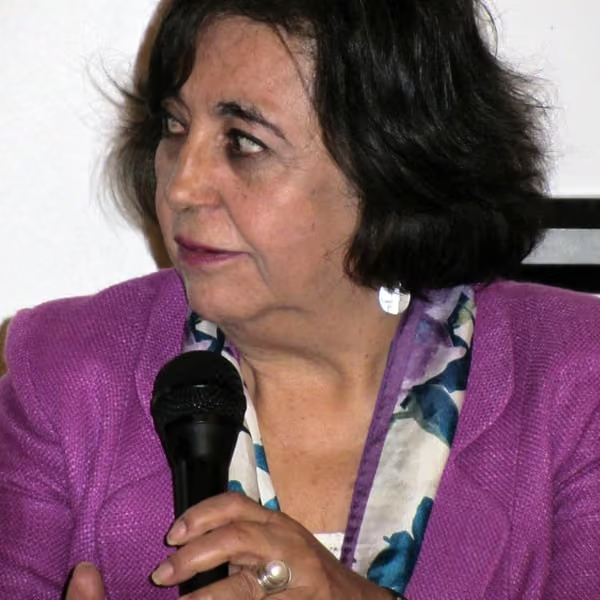
Rodrigo Fernández · Wikimedia Commons · CC BY-SA 4.0
"At 3 years old, or maybe even before, I started playing at doing experiments," she once said. "On the terrace of my parents' house I would gather and mix all sorts of things: cologne, vinegar, leaves, flowers, brick dust, and see what happened." (Translated from Spanish.)
Decades later, that same curiosity ended up in a much narrower and much harder question: what does a calcium ion do when it enters a neuron. Cecilia Hidalgo has spent half a century chasing it, and along the way became the first woman to earn a Doctorate in Sciences from the Universidad de Chile and the first woman to win the Premio Nacional de Ciencias Naturales (Chile's national prize for the natural sciences).
Biochemistry in 1965, doctorate in 1969
She graduated with a Licenciatura in Biochemistry from the Universidad de Chile in 1965, and in 1969 became the first woman to earn a Doctorate in Sciences from that university. Between 1969 and 1972 she did her postdoctoral work at the National Institutes of Health, in Bethesda, and returned to Chile as an assistant professor of biophysics at the Faculty of Chemical and Pharmaceutical Sciences.
Between 1974 and 1986 she worked in Boston: first as a research fellow and then as a staff scientist at the Boston Biomedical Research Institute, and simultaneously as an Associate of Harvard Medical School. She returned to Chile at the end of 1983 and since 1984 has been a professor at the Faculty of Medicine of the Universidad de Chile.
Licenciatura in Biochemistry
Universidad de Chile.
First woman to earn a Doctorate in Sciences from the Universidad de Chile
Postdoctoral fellowship
National Institutes of Health, Bethesda, United States.
Assistant professor of biophysics
Faculty of Chemical and Pharmaceutical Sciences.
Boston
Boston Biomedical Research Institute and Harvard Medical School.
Faculty of Medicine
And professor at the Centro de Estudios Científicos until 2002.
Heads the Cell and Molecular Biology Programme
Instituto de Ciencias Biomédicas.
Director of the Centro FONDAP de Estudios Moleculares de la Célula (FONDAP Centre for Molecular Cell Studies)
Premio Nacional de Ciencias Naturales
First woman to receive it.
A signal that switches on memory
Her line of work is the molecular mechanisms that switch on when the concentration of calcium inside a cell rises for an instant: in neurons and in skeletal and cardiac muscle. That calcium pulse is one of the oldest and most universal ways living things have of telling themselves something.
It is a completely central and essential component in the functioning of living beings.
Cecilia Hidalgo, on calcium, translated from Spanish
What she says about being a woman in Chilean science
Women can be scientists and mothers at the same time.
Interview with the Sociedad de Biología de Chile (Chilean Society of Biology), 2015, translated from Spanish
The system discriminates because of that; the same is not demanded of a woman as of a man.
Cecilia Hidalgo, translated from Spanish
In that same 2015 interview she offered a figure that works better than any argument: "In the Academia de Ciencias de Chile there are 3 of us women out of 36 full members." Years later she herself would go on to preside over that academy.
On whether things have changed, her answer avoids both pessimism and complacency: "It is not a level playing field, although progress is being made. There are still social prejudices, and not only in Chile."
What the sources do not quite settle
In 1969 she became the first woman to earn a Doctorate in Sciences from the Universidad de Chile, and in 2006 the first woman to receive the Premio Nacional de Ciencias Naturales.
The Universidad de Chile, CONICYT and the Sociedad de Biología de Chile agree.
She was born on 10 June 1941 in Santiago.
The year is given by two sources; the full date and place, only by a 2023 press piece. No institutional source — neither the Universidad de Chile nor CONICYT — publishes her date of birth. That is why this page's entry records only the year.
She earned her doctorate a year after graduating, in 1966.
That is how a 2023 press piece tells it. It contradicts five different sources — two of them institutional — that place the doctorate in 1969. It is recorded because it circulates, not because it holds up.
- Universidad de Chile. Perfil oficial de Premios Nacionales
View source → - Universidad de Chile. Nueva presidenta de la Academia Chilena de Ciencias
View source → - CONICYT · Mujeres en Ciencia y Tecnología. Ficha institucional de la agencia estatal de investigación
View source → - Sociedad de Biología de Chile (2015). Entrevista: «Las mujeres podemos ser científicas y madres al mismo tiempo»
View source → - El Mostrador (2023). Única fuente consultada que da fecha y lugar de nacimiento
View source →
How to cite
This is free to reuse under CC BY 4.0, as long as you give credit.
FísicaEterna. (2026). María Cecilia Hidalgo Tapia — biography, FísicaEterna. Retrieved [access date] from https://www.fisicaeterna.cl/en/biographies/cecilia-hidalgo
@misc{fisicaeterna_cecilia_hidalgo,
  author  = {FísicaEterna},
  title   = {María Cecilia Hidalgo Tapia — biography, FísicaEterna},
  year    = {2026},
  url     = {https://www.fisicaeterna.cl/en/biographies/cecilia-hidalgo},
  note    = {CC BY 4.0}
}