Cinna Lomnitz Aronsfrau
His doctoral thesis on how a rock deforms over time became the Lomnitz Law. He was the first director of the Institute of Geophysics of the Universidad de Chile.
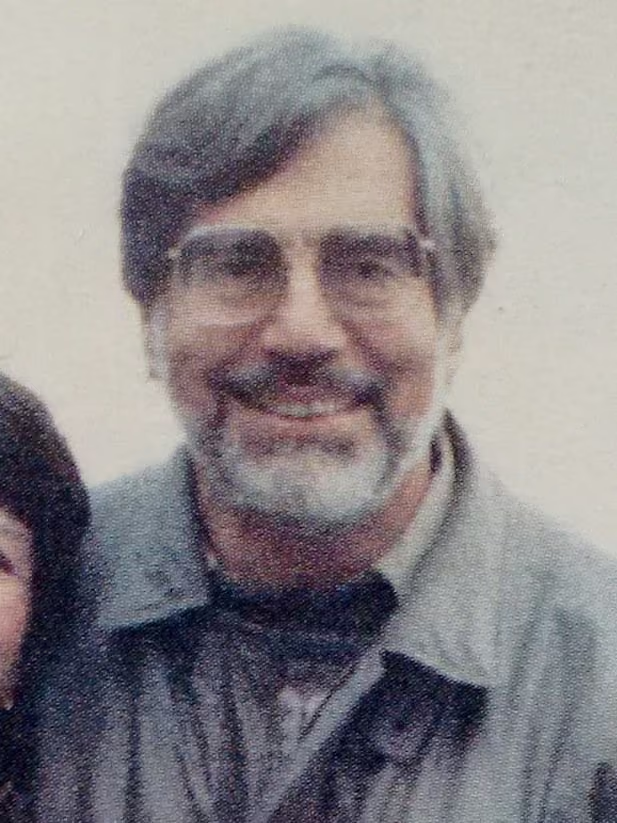
Wikimedia Commons (recorte de una fotografía de 1995) · CC BY-SA 4.0
His Caltech doctoral thesis dealt with something seemingly minor: how an igneous rock deforms when a constant force is applied to it over a long time. The answer turned out to be logarithmic, and Harold Jeffreys formalised it in 1958 as Lomnitz's law. It remains a basic principle of rock rheology.
Two years later, Chile suffered the largest earthquake ever recorded. By then Lomnitz was directing the newly created Instituto de Geofísica at the Universidad de Chile.
From Cologne to Santiago, and from the ground to the theory
He was born in Cologne, Germany, in 1925, and his family went into self-imposed exile while he was a child. He qualified as an engineer at the Universidad de Chile in 1948, took a master's at Harvard in soil mechanics, and earned his doctorate in geophysics at Caltech in 1955 under Hugo Benioff. His thesis —«Creep measurements in igneous rocks with some applications to the theory of aftershocks»— was the one that gave rise to the law that bears his name. He then did a postdoc at Caltech with Charles Richter, of the scale.
In 1957 the Universidad de Chile created the Instituto de Geofísica, successor to the Instituto de Sismología founded by Federico Greve. Lomnitz was its first director. Three years later, on 22 May 1960, a magnitude 9.5 earthquake ruptured a thousand kilometres of fault off Valdivia: the largest ever measured. Lomnitz took an active part in studying it, and decades later would publish a historical survey of Chile's great earthquakes between 1535 and 1960.
A second country, and a second earthquake that changed everything
Engineer, Universidad de Chile
School of Engineering.
Doctorate at Caltech
Geophysics, under Hugo Benioff. Lomnitz's law comes out of this work.
First director of the Instituto de Geofísica
Universidad de Chile.
Valdivia earthquake
Magnitude 9.5, a thousand kilometres of rupture: the largest known earthquake.
Joins UNAM
As a full researcher (investigador titular C).
Founds the Mexican seismic network
RESMAC.
Mexico City earthquake
On 19 September. It redirected his research towards understanding why the city responded the way it did.
Mexican citizenship
That same year he became editor of the journal Geofísica Internacional.
Premio Nacional de Ciencias y Artes
Mexico's national prize for sciences and arts. In 1997, the Premio Universidad Nacional.
Emeritus researcher at UNAM
Dies in Mexico City
On 7 July, aged 91.
The 1985 Mexico City earthquake was devastating in a way its magnitude alone did not explain: the city's lakebed subsoil amplified the shaking at frequencies that resonated with medium-height buildings. Lomnitz devoted the rest of his career to that problem, and became a public figure in Mexican seismology.
What the sources do not quite settle
He was the first director of the Instituto de Geofísica at the Universidad de Chile, created in 1957.
Recorded by the Universidad de Chile itself.
He died on 7 July 2016 in Mexico City, aged 91.
UNAM's journal Geofísica Internacional and Fundación UNAM agree.
He was born on 4 May 1925.
Every source gives the year. The exact day appears only in the English Wikipedia, with no corroboration in Spanish-language sources; that is why the entry records only 1925.
He witnessed the 1960 Valdivia earthquake first-hand.
It circulates in profiles, but no primary source consulted states it. What is documented is his active part in studying the earthquake from the Instituto de Geofísica.
- Universidad de Chile. Semblanza institucional
View source → - Geofísica Internacional · UNAM. In memoriam en la revista que él mismo dirigió
View source → - Fundación UNAM. Perfil y circunstancias de su muerte
View source →
How to cite
This is free to reuse under CC BY 4.0, as long as you give credit.
FísicaEterna. (2026). Cinna Lomnitz Aronsfrau — biography, FísicaEterna. Retrieved [access date] from https://www.fisicaeterna.cl/en/biographies/cinna-lomnitz
@misc{fisicaeterna_cinna_lomnitz,
  author  = {FísicaEterna},
  title   = {Cinna Lomnitz Aronsfrau — biography, FísicaEterna},
  year    = {2026},
  url     = {https://www.fisicaeterna.cl/en/biographies/cinna-lomnitz},
  note    = {CC BY 4.0}
}