Claudio Bunster Weitzman
In 1992 he found a black hole that theory said was impossible. Two years later he connected topology with thermodynamics.
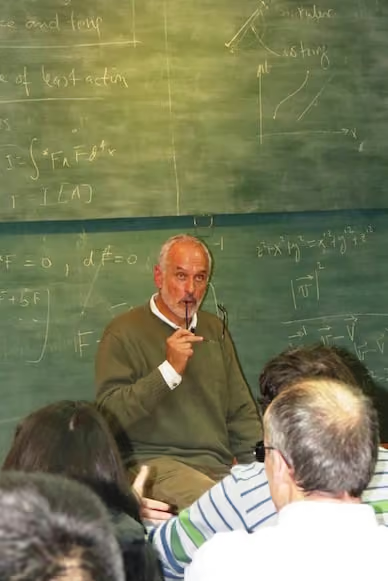
Rafael Rosende Álvarez · Wikimedia Commons · CC BY-SA 3.0
In 1992 he found a solution to Einstein's equations describing a black hole that was supposed not to exist. Two years later he published a result connecting topology — the shape of space — with thermodynamics.
His surname appears twice in the theoretical physics literature: in Jackiw-Teitelboim gravity and in the BTZ black hole. For nearly his entire career he published as Claudio Teitelboim.
Gravitation, gauge and black holes
He was born in Santiago on 15 April 1947, graduated from the Facultad de Ciencias at the Universidad de Chile in 1969, and earned his doctorate at Princeton in 1973. He worked at the Institute for Advanced Study and at the University of Texas at Austin until 1984.
His contributions lie in the theory of electromagnetic radiation, the Hamiltonian formulation of gravitation, and the quantisation of gauge systems: the mathematical apparatus used to try to reconcile general relativity with quantum mechanics. The BTZ black hole —for Bañados, Teitelboim and Zanelli— is a three-dimensional solution that became a standard tool for studying quantum gravity in a manageable setting.
important and sustained contributions in Theoretical Physics
Jury verdict, Premio Nacional de Ciencias Exactas 1995, translated from Spanish
Setting up a research centre far from the capital
In 1984 he returned to Chile and founded the Centro de Estudios Científicos. Years later he moved it to Valdivia, a far from obvious decision: frontier research tends to concentrate where it is already concentrated. The CECs ended up housing not only theoretical physics but also glaciology and cell biology, and mounting expeditions to the ice fields and to Antarctica.
Between 1994 and 2000 he was scientific advisor to president Eduardo Frei Ruiz-Tagle.
to unite our passion for science with our passion for Chile
Claudio Bunster, on the decision to set up the CECs in Valdivia, translated from Spanish
What the sources do not quite settle
He was born on 15 April 1947 in Santiago, graduated in 1969 and earned his doctorate at Princeton in 1973.
This matches between the Universidad de Chile and the English-language Wikipedia.
He founded the Centro de Estudios Científicos in 1984 and received the Premio Nacional de Ciencias Exactas in 1995.
Both sources agree.
The reasons for the surname change from Teitelboim to Bunster.
The English-language Wikipedia offers a family-related explanation and dates it to 2005. It is the only source that does so: no Chilean institutional source explains it, and the Universidad de Chile profile simply uses his current surname. Since this concerns the private life of a living person and there is only a single source, this page does not repeat that version.
The details of the CECs Antarctic expeditions and of "Lago CECs".
They appeared in search summaries, not in primary sources that could be read directly. The centre's own website was not accessible during this research.
The quotations attributed to him on this page are verbatim.
They come from an interview reproduced by the Universidad San Sebastián, read through a summarising tool. It would be worth checking them against the original publication before quoting them elsewhere.
- Universidad de Chile. Perfil oficial de Premios Nacionales, con el fallo del jurado
View source → - Wikipedia (inglés). Trayectoria, distinciones y obra
View source → - Universidad San Sebastián. Entrevista: la vocación, el premio y Valdivia
View source →
How to cite
This is free to reuse under CC BY 4.0, as long as you give credit.
FísicaEterna. (2026). Claudio Bunster Weitzman — biography, FísicaEterna. Retrieved [access date] from https://www.fisicaeterna.cl/en/biographies/claudio-bunster
@misc{fisicaeterna_claudio_bunster,
  author  = {FísicaEterna},
  title   = {Claudio Bunster Weitzman — biography, FísicaEterna},
  year    = {2026},
  url     = {https://www.fisicaeterna.cl/en/biographies/claudio-bunster},
  note    = {CC BY 4.0}
}