Claudio Gay Mouret
In 1830 Chile commissioned a newly arrived French teacher to survey the entire country and write it all down. It took forty years and thirty volumes.
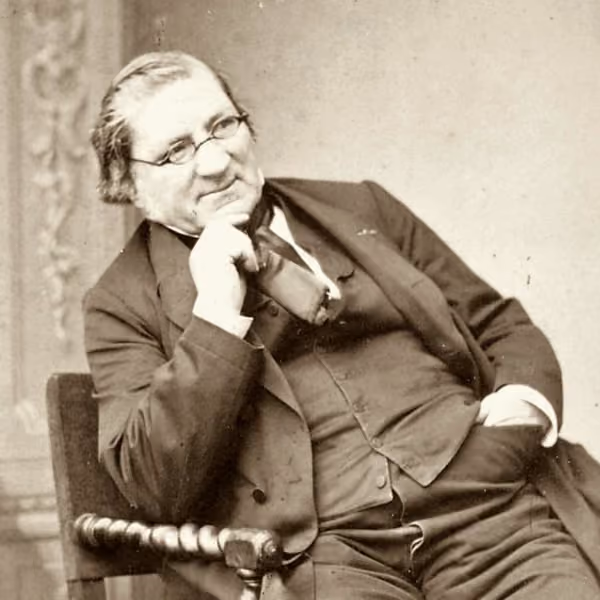
Fotografía de Pierre Petit · Wikimedia Commons · Dominio público
In 1830, a state that had existed for twelve years signed an unusual contract: it paid a thirty-year-old French professor, newly arrived, to travel the length of the country and write down what he found. There was no reliable map, no catalogue of species, no museum. Chile had become independent from Spain without any idea of exactly what it had inherited.
Claudio Gay took forty years to answer that question. The answer was thirty volumes.
A medical student who bolted for botany
Gay was born on 18 March 1800 in Draguignan, in French Provence. At eighteen he was sent to Paris to study medicine and pharmacy, and abandoned both almost immediately to devote himself to the natural sciences. He trained alongside naturalists such as the botanist Juan Bautista Balbis, with whom he travelled to the Alps, northern Italy and several Mediterranean islands.
He arrived in Chile in 1828, hired to teach physics and natural history at the Colegio de Santiago. He came to teach. He ended up doing something else.
Go and look at the country, then write it down
In 1830 he signed a contract with the Chilean government to explore the territory and study its flora, fauna, geography and geology. The commitment was not just to collect: the contract included writing a complete work with that information and drawing up a map of the country.
Over the following years he gathered animal, bird and fish skins, plants, minerals, indigenous artefacts and fossil remains —among them those of a mastodon found in 1835 in Talca—. With those collections he founded the Gabinete de Historia Natural and its library, the origin of today's Museo Nacional de Historia Natural.
Born in Draguignan
Provence, France. Basic schooling in his home town.
Paris
Sent to study medicine and pharmacy; abandons both for the natural sciences.
Arrives in Chile
Hired as a teacher of physics and natural history at the Colegio de Santiago.
The contract
Signs the government's commission to travel the territory and write a complete work about it.
The Talca mastodon
Among the pieces gathered for the Gabinete de Historia Natural are fossilised mastodon remains.
Citizenship by grace
On 29 December, President Manuel Bulnes grants him Chilean nationality.
Geographical Society of Paris
In October he is elected a full member.
Historia física y política de Chile
Thirty volumes, published over twenty-seven years.
Dies in Provence
On 29 November, aged 73, in France.
Thirty volumes still being cited
The Historia física y política de Chile was published between 1844 and 1871 and covered botany, zoology, agriculture, and history and independence. It is not a natural history book with appendices: it is the first attempt to inventory an entire country —its living things, its minerals and its people— in a single work.
The state that commissioned it responded with two uncommon gestures: Chilean citizenship by grace, signed by President Manuel Bulnes on 29 December 1841, and a lifetime pension.
A museum, and the habit of looking
Gay returned to France and died there in 1873. What he left installed in Chile was not just a published work: it was a physical collection, a building to house it, and the idea that a country needs to know what it has. Twenty years after his contract, another European naturalist —Rodulfo Amando Philippi— would take over that cabinet and turn it into a modern museum.
What the sources do not quite settle
He was born on 18 March 1800 in Draguignan and died on 29 November 1873 in Provence.
This agrees across Memoria Chilena (the National Library), the Museo Nacional de Bellas Artes profile, and the other sources consulted.
The 'Historia física y política de Chile' comprises thirty volumes, published between 1844 and 1871.
Memoria Chilena and the Museo Nacional de Bellas Artes agree on the figure. One secondary source mentions "twenty-four volumes of text" in 1855, which probably describes the partial state of the work at that date rather than the total.
He died specifically in Flayosc, a commune in the Var department.
Chilean sources say only "Provence". The precision of Flayosc appears in the English Wikipedia and we could not confirm it in an institutional source.
The Gabinete de Historia Natural was founded on 14 September 1830.
The exact date appears in a children's educational resource from the National Library. Memoria Chilena recognises the founding as Gay's work, but does not date it.
- Memoria Chilena · Biblioteca Nacional de Chile. Claudio Gay Mouret (1800-1873): presentación y cronología
View source → - Biblioteca Nacional de Chile. El naturalista que estudió Chile — presentación del minisitio
View source → - Artistas Visuales Chilenos · Museo Nacional de Bellas Artes. Ficha biográfica, con premios y distinciones
View source → - Aves de Chile. Biografía extensa, con el detalle de las colecciones reunidas
View source → - Wikipedia (inglés). Única fuente consultada que precisa Flayosc como lugar de muerte
View source →
How to cite
This is free to reuse under CC BY 4.0, as long as you give credit.
FísicaEterna. (2026). Claudio Gay Mouret — biography, FísicaEterna. Retrieved [access date] from https://www.fisicaeterna.cl/en/biographies/claudio-gay
@misc{fisicaeterna_claudio_gay,
  author  = {FísicaEterna},
  title   = {Claudio Gay Mouret — biography, FísicaEterna},
  year    = {2026},
  url     = {https://www.fisicaeterna.cl/en/biographies/claudio-gay},
  note    = {CC BY 4.0}
}