Eloísa Díaz Insunza
Chile and Latin America's first female physician; a pioneer who turned women's education into public health.
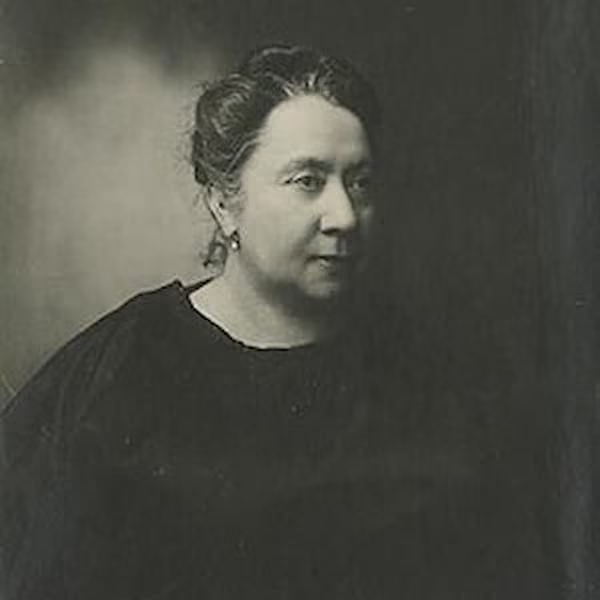
Archivo Fotográfico, Museo Histórico Nacional · inicios del siglo XX · Dominio público
Eloísa Díaz Insunza was born into a Chile where university had not been designed for women. At fifteen she sat the baccalaureate examinations, passed unanimously, and opened up a new scene: a young woman entering Medicine as if the future had already begun.
The student who walked through a closed door
She was born on 25 June 1866 in Santiago, the daughter of Eulogio Díaz Varas and Carmela Insunza. She learned her first letters at the Colegio de Primeras Letras run by Dolores Cabrera de Martínez, and then continued her education at the Liceo Isabel Le Brun de Pinochet, one of the institutions that most firmly championed secular education for women in nineteenth-century Santiago.
Her childhood coincided with a historic change: in 1877, when she was eleven, minister Miguel Luis Amunátegui signed the decree that allowed women to sit examinations valid for entering university. That legal act was no abstraction for Eloísa; it became the concrete door through which she would walk a few years later.
Her presence in the lecture halls was exceptional even in the everyday details. She attended accompanied by her mother, and in Anatomy she was separated from her classmates by a screen. But that physical boundary was never an intellectual one: throughout her studies she stood out for her performance and was recognised among the best students of clinical medicine and obstetrics in her class.
When she received her degree in 1887, she gained more than a profession. She turned the 1877 Amunátegui Decree into a living, verifiable fact: a woman could enter university, perform at the highest level, and practise medicine with a public calling.
Academic excellence against the inertia of the age
In 1886 she presented her dissertation, Breves observaciones sobre la aparición de la pubertad en la mujer chilena y las predisposiciones patológicas del sexo ("Brief observations on the onset of puberty in Chilean women and the pathological predispositions of the sex"). The subject was bold, because it placed women's health at the centre of medical debate, at a time when that field had been treated with distance, prejudice or plain omission.
The scene of her baccalaureate examination carried enormous symbolic weight. She sat the exam at the Instituto Nacional before a panel that included Diego Barros Arana, while rector Ignacio Domeyko and Amunátegui himself waited for the results. Her unanimous pass was celebrated as a public event, not merely a private achievement.
Education is not the ruin of women: it is their salvation.
Eloísa Díaz Insunza, graduation dissertation and address, translated from Spanish
Her most quoted line was not an ornamental slogan: it was a political and public-health thesis. Educating women did not weaken society, it strengthened it. Eloísa proved it with her own life, and then with decades of public service.
A medicine placed in the service of childhood
Eloísa could have chosen a comfortable private practice. Instead, she steered her work towards public health. From hospitals, teacher-training colleges, and later from the head office of the School Medical Service, she understood that childhood illness was not fought with prescriptions alone, but with sustained policies of hygiene, prevention and nutrition.
Her first posting was at the Escuela Normal de Preceptores del Sur (a teacher-training college), where she worked between 1889 and 1897 as both teacher and physician. In 1891 she also began practising at the Hospital San Borja, building up clinical experience while laying the foundation of her great legacy: a preventive, public and social school medicine.
School meals
She championed compulsory school breakfasts as a measure of social justice and public health.
Mass vaccination
She organised preventive campaigns in schools to protect low-income children.
Hygiene and prevention
She drove health checks against tuberculosis, rickets and other school illnesses.
Education for women
Her career made visible that educating women strengthened the whole country.
Her insistence on feeding poor children at school anticipated a modern understanding of wellbeing: learning, growing and healing are part of the same social problem. That insight still holds today.
In 1910 she officially represented Chile at the International Scientific Congress of Medicine and Hygiene in Buenos Aires, where she was recognised as an "Illustrious Woman of the Americas". That title distilled what her work had already shown: her medicine was not only clinical, it was social reform.
Milestones of a public life
Born in Santiago
Born on 25 June, the daughter of Eulogio Díaz Varas and Carmela Insunza.
Amunátegui Decree
Chile allows women to sit examinations valid for entering university.
Historic entry into Medicine
Sits the baccalaureate examinations and enters the School of Medicine at the Universidad de Chile.
Degree and dissertation
Graduates on 27 December with a dissertation on the health of Chilean women.
First female physician and surgeon
Receives her degree as Physician and Surgeon on 3 January, from the hands of President José Manuel Balmaceda.
Public service and teaching
Begins work as a teacher and physician at the Escuela Normal de Preceptores del Sur.
Hospital San Borja
Begins clinical work at the Hospital San Borja, consolidating her medical practice.
Report on school nutrition
Publishes a key report on the feeding of poor children in public schools.
Illustrious Woman of the Americas
Represents Chile in Buenos Aires and is recognised for her work in social medicine.
School Medical Service
Is appointed director of Chile's School Medical Service.
Retirement
Retires from active service after decades of public work.
Death
Dies in Santiago aged 84, leaving a decisive legacy in health and education.
A figure that still raises questions
Eloísa Díaz's importance does not fit inside the label of "first". She was first, yes, but her greatness lies in what she did after opening that door. She used her position to turn medicine into a tool of collective protection, and to show that women's education was a force for national modernisation.
She lived to see some of the transformations she had pushed for from early on: school breakfasts became public policy, mass vaccination became institutionalised, and school medicine developed as a discipline. She was also an early voice for women's suffrage, decades before Chilean women could vote.
A life without personal ambition
Her final years were austere and solitary, marked by the modesty of someone who devoted resources, time and prestige to the service of others. That moral dimension is inseparable from her biography: she did not seek to enrich herself through her pioneering position, but to extend care to those who needed it most.
Eloísa Díaz was not only the first woman doctor in Latin America: she was a historical demonstration that science, when it opens up, also learns to care better.
Eloísa Díaz Insunza · 1866 — 1950
- Memoria Chilena — Biblioteca Nacional de Chile. Biografía, contexto histórico y documentos sobre Eloísa Díaz.
View source → - Universidad de Chile — Historia institucional. Registros y reseñas sobre su titulación y legado universitario.
View source → - Facultad de Medicina, Universidad de Chile. Hitos de la primera médica cirujana de Chile.
View source → - Google Doodles — Eloísa Díaz. Homenaje internacional por su 152.° aniversario.
View source →
How to cite
This is free to reuse under CC BY 4.0, as long as you give credit.
FísicaEterna. (2026). Eloísa Díaz Insunza — biography, FísicaEterna. Retrieved [access date] from https://www.fisicaeterna.cl/en/biographies/eloisa-diaz
@misc{fisicaeterna_eloisa_diaz,
  author  = {FísicaEterna},
  title   = {Eloísa Díaz Insunza — biography, FísicaEterna},
  year    = {2026},
  url     = {https://www.fisicaeterna.cl/en/biographies/eloisa-diaz},
  note    = {CC BY 4.0}
}