Ernestina Pérez Barahona
She graduated as a physician seven days after Eloísa Díaz, and spent the rest of her life proving that degree had not been an exception.
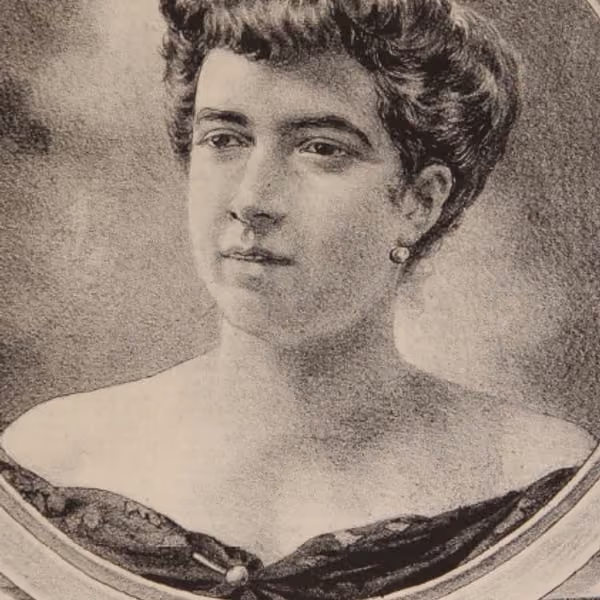
Autor no identificado, 1904 · Memoria Chilena vía Wikimedia Commons · Dominio público
On 10 January 1887, Ernestina Pérez Barahona received her degree as a physician and surgeon from the Universidad de Chile. Seven days earlier, Eloísa Díaz had received hers. That week's difference turned her, forever, into "Chile's second female doctor" — an elegant way of telling an entire life by what it was not.
It is worth looking at what she was. Two years before she had the right to practise, she was already publishing in the Revista Médica de Chile. She studied in London, Paris and Berlin on a state scholarship. She wrote a treatise against the corset. She was the first South American professional woman admitted to the Academy of Medicine in Berlin. None of that is second place.
She published as a student in the country's medical journal
She graduated with a bachelor's degree in Humanities in 1883 and a bachelor's degree in Medicine and Pharmacy in 1885. That same year, and the next, she published papers in the Revista Médica de Chile: she was still a student, at a faculty that had been admitting women for less than a decade.
Her degree came through on 10 January 1887. Her graduation thesis dealt with hygiene — its exact title is one of the things the sources cannot agree on, and it is covered at the end of this page. That same year Valparaíso went through a cholera epidemic; the city ended up naming her a distinguished citizen for her work during the outbreak.
London, Paris, Berlin
She obtained a scholarship from the Chilean state to study at the Universidad Federico Guillermo, in Germany — now the Universidad Humboldt de Berlín — and also studied in London and Paris. She returned specialised in gynaecology and child development, the two fields she would work in for the rest of her career.
In 1910 she was admitted to the Academy of Medicine in Berlin. According to the Biblioteca del Congreso Nacional (Chile's National Congress Library), she was the first professional woman from South America to achieve this.
Hygiene, gynaecology and a treatise against the corset
Higiene del corsé (Hygiene of the corset)
Presented at a congress in Buenos Aires. A medical argument against a garment taken for granted as obligatory: hygiene as the territory where medicine argues with custom.
Lecciones de ginecología (Lessons in gynaecology)
Her most cited work, published the same year she entered the Academy of Medicine in Berlin.
Revista Médica de Chile
Two papers published before she graduated, while she was still a student at the Faculty of Medicine.
She was also director of the Asociación de Mujeres Universitarias de Chile (Association of Chilean University Women). Her career did not stop at the surgery: much of her work aimed to keep open the door she herself had walked through.
What the sources do not quite settle
She received her degree as a physician and surgeon from the Universidad de Chile on 10 January 1887, seven days after Eloísa Díaz.
The Universidad de Chile Faculty of Medicine, the Biblioteca del Congreso Nacional and the Revista Médica de Chile article (2019) all agree.
She was born on 8 August 1865 in Valparaíso.
The Universidad de Chile Faculty of Medicine and the Revista Médica de Chile article give 1865. The Biblioteca del Congreso Nacional and a Memoria Chilena record give 1868. The exact date — 8 August — appears only in the sources that say 1865, which makes them the more specific ones, but the contradiction remains open.
Her graduation thesis was titled "Elementos de higiene popular" (Elements of popular hygiene).
That is the title given by the Universidad de Chile Faculty of Medicine. The Revista Médica de Chile article calls it "Higiene social" (Social hygiene). Both are serious sources and we could not review the original document.
She died in 1951.
All sources consulted agree. The Revista Médica de Chile article narrows the deaths of both doctors to the window between November 1950 and June 1951, without giving a day for either.
- Facultad de Medicina · Universidad de Chile. Ficha institucional: estudios, títulos, obras y distinciones
View source → - Biblioteca del Congreso Nacional de Chile. Mujeres Científicas Chilenas: cargos, reconocimientos y epidemia de cólera
View source → - Revista Médica de Chile (2019). Las primeras médicas de Chile y Latinoamérica: Eloísa Díaz Insunza y Ernestina Pérez Barahona
View source → - Memoria Chilena · Biblioteca Nacional de Chile. Ficha de archivo (consigna los años 1868-1951)
View source →
How to cite
This is free to reuse under CC BY 4.0, as long as you give credit.
FísicaEterna. (2026). Ernestina Pérez Barahona — biography, FísicaEterna. Retrieved [access date] from https://www.fisicaeterna.cl/en/biographies/ernestina-perez
@misc{fisicaeterna_ernestina_perez,
  author  = {FísicaEterna},
  title   = {Ernestina Pérez Barahona — biography, FísicaEterna},
  year    = {2026},
  url     = {https://www.fisicaeterna.cl/en/biographies/ernestina-perez},
  note    = {CC BY 4.0}
}