Fernando Mönckeberg Barros
In 1950, 180 of every thousand Chilean children died before turning one. Today seven do. Much of that difference bears his signature.
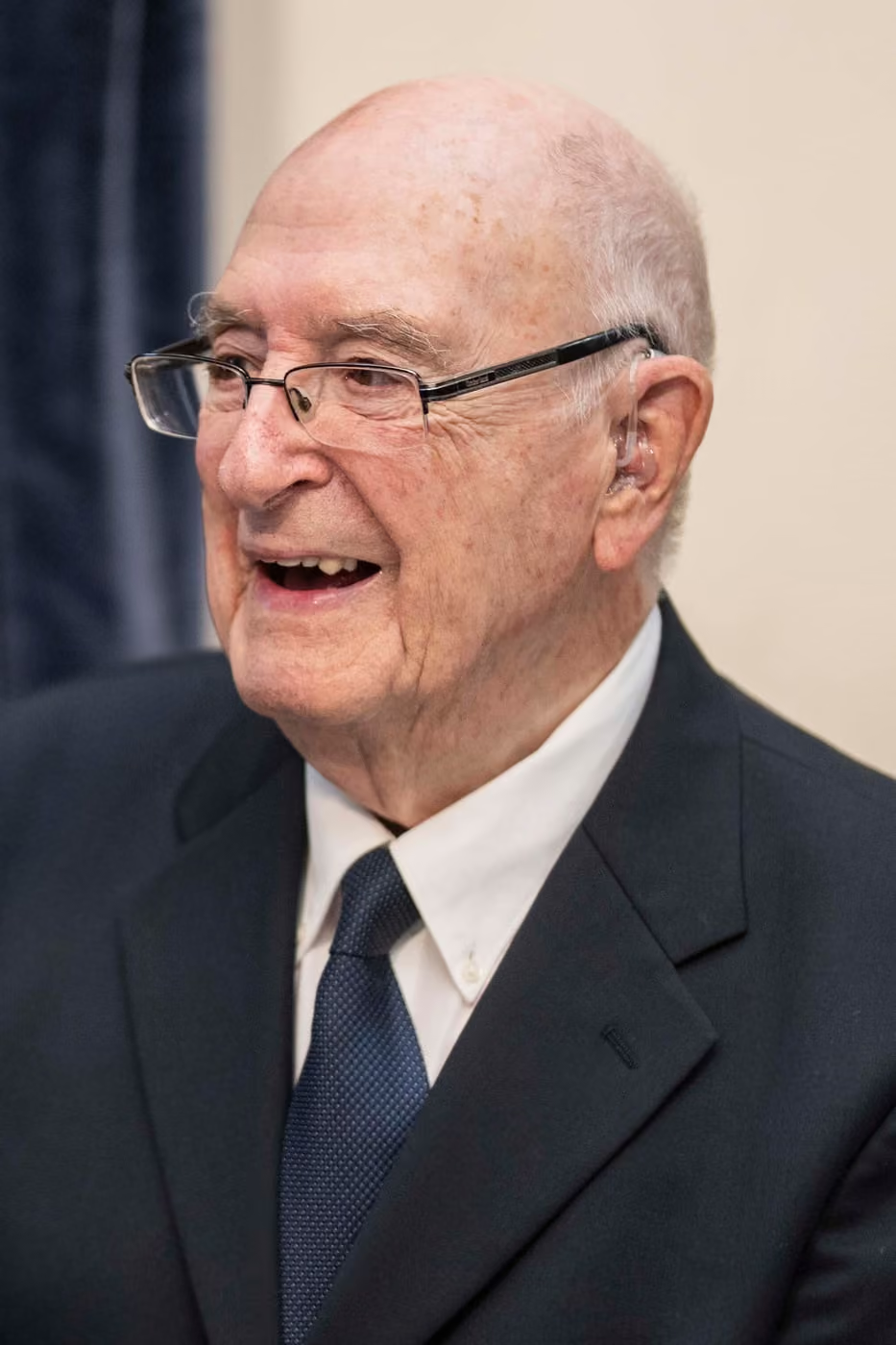
Gobierno de Chile · Wikimedia Commons · CC BY 3.0 CL
In the mid-twentieth century, in the La Legua neighbourhood, 40% of children died before turning fifteen and life expectancy was thirty-eight years. Child malnutrition was treated as a condition of the country, not as a problem with a solution.
A paediatrician freshly back from Harvard decided it did have a solution, and spent the next seventy years proving it. Chile's infant mortality rate in the first year of life fell from 180 per thousand to seven.
What changed
None of those figures is the work of one person alone: they are the result of public policy, of the Servicio Nacional de Salud (National Health Service), of the national supplementary feeding programme, and of decades of work by thousands of staff. But the argument that drove those policies, and much of the evidence that backed them, came out of his laboratory.
Why early malnutrition does not get made up for later
Mönckeberg was born in Santiago on 26 June 1926 and qualified as a doctor at the Universidad Católica in 1952. Between 1958 and 1960 he was a research fellow in immunology at Boston Children's Hospital, on a Guggenheim Fellowship, and was an associate professor of paediatrics at Harvard.
His decisive contribution was scientific before it was political: showing that malnutrition in the first years of life is not a delay that food can make up for later, but structural damage to brain development. That turned infant nutrition into an emergency rather than an act of charity.
In a malnourished child, the neurons' branches are atrophied. The brain is left damaged for the rest of that person's life.
Fernando Mönckeberg, translated from Spanish
Physician and surgeon
Pontificia Universidad Católica de Chile.
Laboratorio de Investigaciones Pediátricas
Universidad de Chile. The seed of the INTA.
Boston Children’s Hospital
Research in immunology, on a Guggenheim Fellowship.
Founds the INTA
Instituto de Nutrición y Tecnología de los Alimentos (Institute of Nutrition and Food Technology), Universidad de Chile. He directs it for more than twenty years.
Jaque al subdesarrollo (Checkmate to underdevelopment)
The first of several books. Later: "Políticas de alimentación y nutrición en Chile" (1976) and "Desnutrición infantil" (1988).
Founds CONIN
Corporación para la Nutrición Infantil (Corporation for Child Nutrition): the network of recovery centres.
Professor Emeritus
Universidad de Chile. That same year he steps down as director of the INTA.
Premio Nacional de Ciencias Aplicadas y Tecnológicas
Chile's National Prize for Applied and Technological Sciences.
Premio Nacional de Medicina
His second National Prize.
The INTA is renamed after him
Instituto de Nutrición y Tecnología de los Alimentos Doctor Fernando Mönckeberg Barros.
Having won the war on hunger, another one began
My friends tell me I made such a fuss about malnutrition that we now overcorrected. Today, obesity is an epidemic.
Fernando Mönckeberg, translated from Spanish
It is one of the most quoted ironies of Chilean public health, and he was the first to put it into words. The same country that eradicated child malnutrition now has one of the highest rates of childhood obesity in the OECD, and much of the INTA now works on that problem.
- More than 130 articles in scientific journals and more than 60 chapters in specialised books.
- Rector of the Universidad Santo Tomás (1994-1996) and of the Universidad Iberoamericana de Ciencias y Tecnología (1998-1999).
- Dean of the Faculty of Health Sciences at the Universidad Diego Portales since 2001.
- Two National Prizes: Ciencias Aplicadas y Tecnológicas (1998) and Medicina (2012).
What the sources do not quite settle
He is alive. He turned one hundred in 2026.
This was expressly verified: no record shows a date of death, and the 2026 press covered his hundredth birthday.
He received the Premio Nacional de Ciencias Aplicadas y Tecnológicas in 1998 and the Premio Nacional de Medicina in 2012.
Three or more independent sources agree on each one.
He founded the INTA in 1972.
This is the majority version. A page from the institute itself describes a three-step transition — a laboratory in 1954, a Department of Nutrition in 1972, a formal institute in 1976 — so the year depends on what counts as "founding."
He was born on 26 June 1926.
Spanish-language Wikipedia and Wikidata agree. A Czech authority database records 1925.
- Universidad de Chile. Perfil oficial de Premios Nacionales
View source → - INTA · Universidad de Chile. Ficha del instituto que fundó y que hoy lleva su nombre
View source → - Infobae (2019). Entrevista extensa, fuente de las cifras y de sus citas
View source →
How to cite
This is free to reuse under CC BY 4.0, as long as you give credit.
FísicaEterna. (2026). Fernando Mönckeberg Barros — biography, FísicaEterna. Retrieved [access date] from https://www.fisicaeterna.cl/en/biographies/fernando-monckeberg
@misc{fisicaeterna_fernando_monckeberg,
  author  = {FísicaEterna},
  title   = {Fernando Mönckeberg Barros — biography, FísicaEterna},
  year    = {2026},
  url     = {https://www.fisicaeterna.cl/en/biographies/fernando-monckeberg},
  note    = {CC BY 4.0}
}