Francisco Varela García
With Maturana he defined what it is to be alive. Then he spent thirty years asking what it is, exactly, to have an experience.
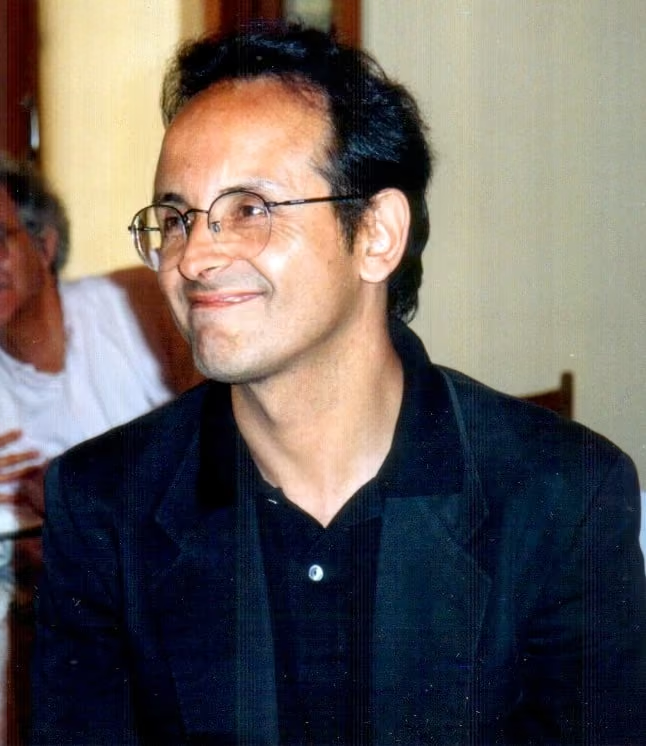
What distinguishes a living being from a very complicated machine? The answer Varela gave together with Humberto Maturana in the early seventies was that a living being produces itself: its organisation continuously generates the components that sustain it. They called it autopoiesis.
He spent the following thirty years on a more uncomfortable question: if that is what it is to be alive, what, exactly, is it to have an experience?
An insect's retina, and an idea that belonged to no one else
He was born in Talcahuano on 7 September 1946. He studied medicine at the Universidad Católica between 1964 and 1966 and then biology at the Universidad de Chile, where he was a disciple of Humberto Maturana. He did his doctorate at Harvard: his thesis, Insect Retinas: Information processing in the compound eye, was defended in 1970 under the supervision of Torsten Wiesel, who years later would win the Nobel Prize.
Back in Chile he published with Maturana De máquinas y seres vivos ("Of Machines and Living Beings", 1973), the text in which autopoiesis appears. It is one of the Chilean conceptual contributions with the widest international circulation: it is used in biology, cognitive science, sociology and systems theory.
October 1973
Doctorate at Harvard
Thesis on insect retinas, supervised by Torsten Wiesel.
De máquinas y seres vivos
With Humberto Maturana. He leaves Chile that October.
Principles of Biological Autonomy
His own development of the idea of biological autonomy.
Autopoiesis and Cognition
The English-language version, with Maturana, that internationalised the concept.
Max Planck Institute
Researcher in Germany.
Co-founds the Mind and Life Institute
With R. Adam Engle, for dialogue between science and Buddhism.
El árbol del conocimiento
With Maturana. The book that brought these ideas to the general public.
Research director at the CNRS
In Paris. He led a research group there until his death.
The Embodied Mind
With Evan Thompson and Eleanor Rosch: cognition as something that happens in a body, not in an abstraction.
Dies in Paris
On 28 May, aged 54.
Neurophenomenology
From the CNRS, Varela proposed something that sounded like heresy to 1990s neuroscience: that a first-person account of experience — what someone says is happening inside them — is not subjective noise to be discarded, but data that must be gathered with method and set in dialogue with brain measurements. He called this programme neurophenomenology.
From there also came his interest in contemplative traditions, which have spent centuries training precisely that inward observation. In 1987 he co-founded with R. Adam Engle the Mind and Life Institute, which organises meetings between scientists and Buddhist practitioners. Varela practised Tibetan Buddhism.
What the sources do not quite settle
He was born on 7 September 1946 in Talcahuano and died on 28 May 2001 in Paris, aged 54.
Two independent sources agree on both dates, with the exact day.
His doctoral thesis, defended at Harvard in 1970, was supervised by Torsten Wiesel.
The English-language Wikipedia and Infoamérica agree. Wiesel, his thesis supervisor, should not be confused with Maturana, who was his teacher in Chile before the doctorate.
"El árbol del conocimiento" was published in 1987.
The English-language Wikipedia gives 1987; Infoamérica gives 1985. There are also later revised editions.
His exact itinerary in exile between 1973 and 1980.
One source describes Costa Rica, then the University of Colorado and NYU between 1975 and 1980. Another places him at NYU directly from 1973. It could not be resolved.
This page does not quote his own words.
The two sources with first-person quotes were not accessible. Rather than attribute to him phrases that could not be checked at their source, it is preferable to say they are missing.
- Wikipedia (inglés). Cronología, obra y fechas
View source → - Infoamérica. Perfil académico con formación y trayectoria
View source → - Biological Research · SciELO. «Los derroteros científicos de Francisco Varela»
View source → - Mind and Life Institute. La institución que cofundó en 1987
View source →
How to cite
This is free to reuse under CC BY 4.0, as long as you give credit.
FísicaEterna. (2026). Francisco Varela García — biography, FísicaEterna. Retrieved [access date] from https://www.fisicaeterna.cl/en/biographies/francisco-varela
@misc{fisicaeterna_francisco_varela,
  author  = {FísicaEterna},
  title   = {Francisco Varela García — biography, FísicaEterna},
  year    = {2026},
  url     = {https://www.fisicaeterna.cl/en/biographies/francisco-varela},
  note    = {CC BY 4.0}
}