Héctor Croxatto Rezzio
He lived 102 years and published in "Science" and "Nature" when almost no one in Chile published anywhere.
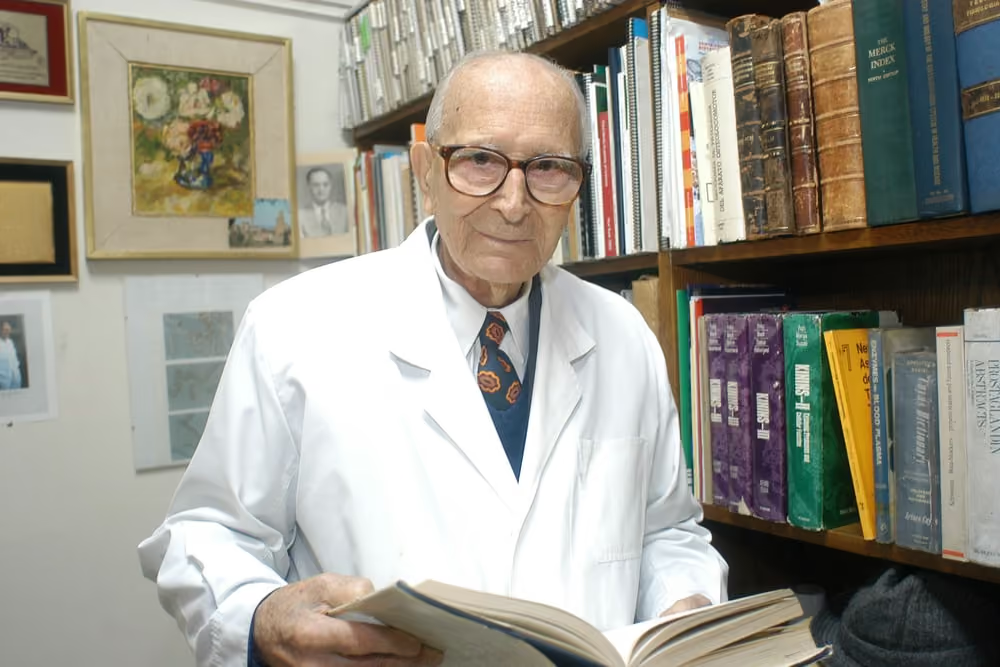
Pontificia Universidad Católica de Chile · Wikimedia Commons · CC BY-SA 2.0
In 1938 he travelled to Switzerland to present a paper at the World Congress of Physiology. He was the first Chilean to present research at an international scientific congress. He was thirty years old.
He died in 2010, aged 102, after publishing more than a dozen articles in Science and Nature and training much of twentieth-century Chilean physiology.
Valparaíso, Santiago, Basel, Harvard
He was born in Valparaíso on 3 July 1908. He qualified as a physician and surgeon at the Universidad de Chile in 1930, but as early as 1928 he was head of coursework for the chair of Biological Chemistry. He undertook postgraduate studies in Basel and, between 1945 and 1946, at Harvard Medical School with Edwin Cohn and Otto Krayer.
Physician and surgeon
Universidad de Chile.
First Chilean at an international scientific congress
World Congress of Physiology, Switzerland.
Publishes in Science
Together with his brother Raúl.
Dean of Medicine
Universidad Católica.
First director of the CPEIP
The Ministry of Education's training centre, under minister Juan Gómez Millas.
Academia Chilena de Ciencias
Inducted into the Instituto de Chile.
The kallikrein finding
Discovers that the urine of hypertensive rats contains much less kallikrein than that of normal rats.
Pontifical Academy of Sciences
Appointed member by the Vatican, on 2 December.
Premio Nacional de Ciencias
For his studies in experimental endocrinology and arterial hypertension.
Co-founds the Academia de Ciencias del Tercer Mundo
Today The World Academy of Sciences (TWAS).
Dies in Santiago
On 28 September, aged 102.
Why blood pressure rises
His central line of research was vasoactive peptides: fragments of plasma proteins that, released through hydrolysis, regulate the resistance of blood vessels. He helped clarify the role of angiotensin in controlling blood pressure, one of the most productive scientific stories of the twentieth century.
In 1970 he found that the urine of hypertensive rats has significantly lower amounts of kallikrein than that of normotensive rats — a clue about the kallikrein-kinin system and its relationship to hypertension.
What the sources do not quite settle
He died on 28 September 2010, aged 102.
This matches across every source consulted.
He received the Premio Nacional de Ciencias in 1979.
Recorded by both the Universidad Católica and the Universidad de Chile.
He was born on 3 July 1908 in Valparaíso.
This is the majority version (Universidad Católica, Universidad de Chile). The Vatican's Pontifical Academy of Sciences gives 28 July; La Tercera gave 1907, but its own article says he died "aged 102", which only works out with 1908.
He was full professor of Physiology at the Universidad Católica from 1933.
One source gives 1933, and the Vatican profile gives 1934.
- Pontificia Universidad Católica de Chile. Ficha oficial de Premios Nacionales
View source → - Universidad de Chile. Perfil oficial de Premios Nacionales
View source → - Pontificia Academia de Ciencias (Vaticano). Ficha de académico, con fecha de nombramiento
View source → - La Tercera (2010). Obituario
View source →
How to cite
This is free to reuse under CC BY 4.0, as long as you give credit.
FísicaEterna. (2026). Héctor Croxatto Rezzio — biography, FísicaEterna. Retrieved [access date] from https://www.fisicaeterna.cl/en/biographies/hector-croxatto
@misc{fisicaeterna_hector_croxatto,
  author  = {FísicaEterna},
  title   = {Héctor Croxatto Rezzio — biography, FísicaEterna},
  year    = {2026},
  url     = {https://www.fisicaeterna.cl/en/biographies/hector-croxatto},
  note    = {CC BY 4.0}
}