Humberto Maturana Romesín
He studied how a frog sees and ended up proposing that living beings make themselves. Autopoiesis left a biology laboratory and moved into philosophy, therapy and education.
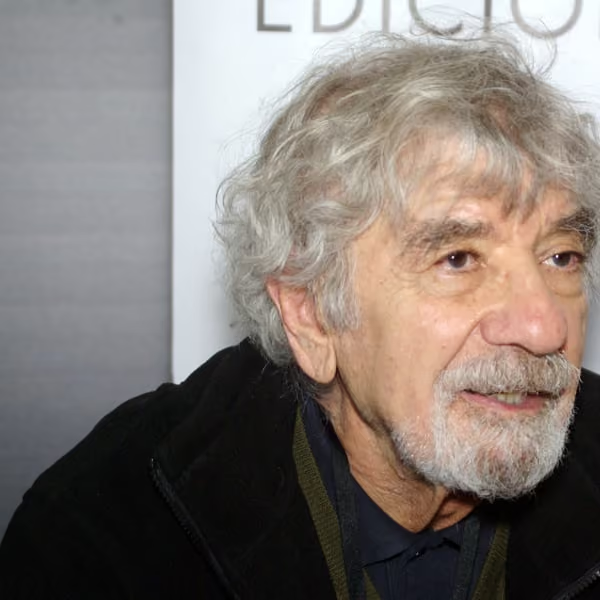
Rodrigo Fernández · Wikimedia Commons · CC BY-SA 4.0
In the late 1950s, in an MIT lab, a group of researchers asked themselves a seemingly modest question: what exactly does a frog see? Measuring the response of its retina, they found something uncomfortable. The frog's eye does not send its brain a picture of the world. It sends a handful of very specific signals —moving edges, dark spots the size of an insect— and the rest, quite simply, does not exist for it.
One of the Chileans in that lab was Humberto Maturana. The conclusion he drew stayed with him for the rest of his life: if the nervous system does not copy the world but constructs it, then the question "how do we know?" is a question of biology, not philosophy.
Medicine, London, Harvard
He was born in Santiago on 14 September 1928 and studied at Liceo Manuel de Salas. In 1950 he entered the Universidad de Chile's Faculty of Medicine. In 1954 he moved to University College London to study anatomy and neurophysiology on a Rockefeller Foundation fellowship, and in 1958 he earned his PhD in Biology from Harvard University.
Between 1958 and 1960 he was a research associate in the Department of Electrical Engineering at the Massachusetts Institute of Technology. That a biologist worked in an electrical engineering department is not a curious detail: it is where the questions about information, control and systems that he would carry into biology were being worked out in those years.
Born in Santiago
On 14 September. He studied at Liceo Manuel de Salas.
Medicine at the Universidad de Chile
University College London
Anatomy and neurophysiology, on a Rockefeller Foundation fellowship.
PhD in Biology at Harvard
MIT
Research associate in the Department of Electrical Engineering.
Returns to Chile
Second assistant in the Biology course of the Faculty of Medicine.
Faculty of Sciences
Full Professor in the Department of Biology at the Universidad de Chile.
Autopoiesis
Creates and develops the concept together with Francisco Varela.
Premio Nacional de Ciencias
Dies in Santiago
On 6 May, aged 92.
Living things manufacture themselves
In the 1970s, together with Francisco Varela, Maturana created the concept of autopoiesis: the idea that a living being is a system that continuously produces the very components that produce it. It is defined not by what it is made of nor by what it does, but by that circularity. A cell is alive because it manufactures itself, and stops being so when that network breaks down.
The consequence that interested him most was not biochemical but epistemological. If the organism operates closed upon itself, it does not "receive information" from its environment: the environment only triggers changes whose shape depends on the organism itself. Knowing stops being a matter of copying the world and becomes a way of living in it.
- The Premio Nacional panel singled him out, specifically, for his research into visual perception in vertebrates.
- Autopoiesis moved out of biology and was taken up in family therapy, systems theory, law and management science.
- Between 1965 and 2000, in the Department of Biology of the Faculty of Sciences, he trained several generations of Chilean biologists.
- In 2000 he founded the Instituto de Formación Matríztica together with Ximena Dávila.
When biology went to the bookshop
De máquinas y seres vivos (Autopoiesis and Cognition)
The text where autopoiesis is formulated as a theory of the organisation of living things. Sources date it between 1972 and 1973.
El árbol del conocimiento (The Tree of Knowledge)
The biological roots of human understanding. The book that took the idea out of academia and to the general reader.
El sentido de lo humano
Collects his work on language, emotion and coexistence. Chilean sources date it to 1992 or 1995.
In 2014 he received the Norbert Wiener Gold Medal, the recognition given by cybernetics —the discipline he had crossed over from biology half a century earlier—. He died in Santiago on 6 May 2021.
What the sources do not quite settle
He was born in Santiago on 14 September 1928 and died on 6 May 2021.
The Universidad de Chile's Premios Nacionales profile, its obituary at the same university, and the review from the Pontificia Universidad Católica de Valparaíso all agree.
He moved from London to Harvard in 1956.
This is stated in the PUCV review. The Universidad de Chile's profiles only record that he earned his doctorate in 1958, without saying when he arrived.
He founded the Instituto de Ciencias and the Faculty of Sciences of the Universidad de Chile in 1965.
This appears in the Universidad de Chile's obituary. Neither his own Premios Nacionales profile nor the PUCV review mentions it: both say only that in 1965 he reached the rank of Full Professor. We could not confirm it in a third source.
The exact years of 'De máquinas y seres vivos' and 'El sentido de lo humano'.
For the first, both 1972 and 1973 circulate, and Memoria Chilena catalogues it as '1972-1973'. For the second, PUCV says 1992 and Memoria Chilena says 1995. Both versions are given rather than choosing one.
- Universidad de Chile. Perfil oficial de Premios Nacionales
View source → - Universidad de Chile (2021). Legado del Dr. Humberto Maturana Romesín (1928-2021)
View source → - Pontificia Universidad Católica de Valparaíso. Reseña del académico Humberto Augusto Maturana Romesín
View source → - Memoria Chilena · Biblioteca Nacional de Chile. Ficha de autor y catálogo de obras
View source →
How to cite
This is free to reuse under CC BY 4.0, as long as you give credit.
FísicaEterna. (2026). Humberto Maturana Romesín — biography, FísicaEterna. Retrieved [access date] from https://www.fisicaeterna.cl/en/biographies/humberto-maturana
@misc{fisicaeterna_humberto_maturana,
  author  = {FísicaEterna},
  title   = {Humberto Maturana Romesín — biography, FísicaEterna},
  year    = {2026},
  url     = {https://www.fisicaeterna.cl/en/biographies/humberto-maturana},
  note    = {CC BY 4.0}
}