Ignacio Domeyko Ancuta
He arrived in La Serena in 1838 on a six-year contract. He stayed fifty-one years, and completely reshaped how science was taught in Chile.
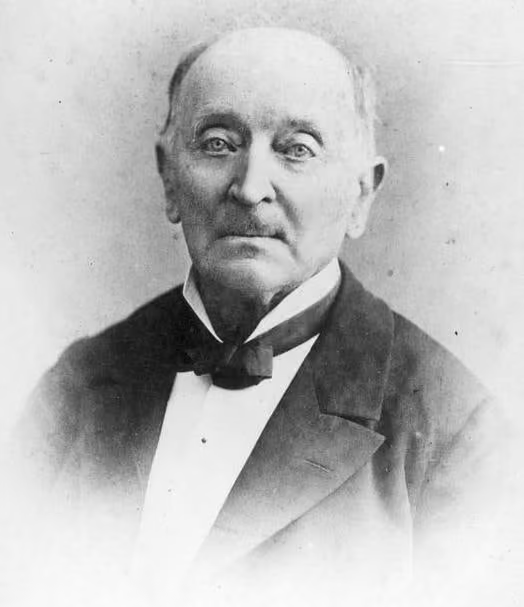
Narodowe Archiwum Cyfrowe (Archivo Nacional Digital de Polonia), c. 1850 · Dominio público
The contract said six years. A thirty-five-year-old Polish mineralogist, exiled in Paris since the failed uprising against Russia, agreed to teach chemistry and mineralogy at the Colegio de Coquimbo. He landed in La Serena on 2 June 1838.
He died in Santiago fifty-one years later, a Chilean citizen by special grant, after having been rector of the Universidad de Chile for sixteen years and having remade, from the ground up, how the sciences were taught in the country.
Vilnius, prison, the uprising and exile
He was born on 31 July 1802 in Niedźwiadka, then under the Russian Empire. He entered the University of Vilnius in 1817 and graduated in Physical and Mathematical Sciences. In 1821 he was imprisoned for Polish independence activities; in that prison he became friends with the poet Adam Mickiewicz, who would later immortalise him in his work.
In 1830 he joined the Polish uprising against Russia. It failed, and in 1832 he sought asylum in France. In Paris he studied at the Sorbonne, the Collège de France and the École des Mines, graduating in 1837 as a mining engineer. The following year he accepted the Chilean contract.
Fourteen students who became Chile's first mining engineers
Between 1838 and 1846 he taught courses in La Serena on metal and mineral assaying, chemical analysis, mine operation and surveying. His students —some fourteen of them— were the first mining engineers trained in the country, at the very moment when mining in the north was becoming the engine of the Chilean economy.
At the same time he travelled the country. The mineral domeykite, a copper arsenide, has borne his name since 1845. So do the town of Domeyko, in Atacama, and the Domeyko mountain range, between Antofagasta and Atacama.
Arrives in Coquimbo
On 2 June, with a six-year contract.
Founding of the Universidad de Chile
He takes part in it and publishes «El modo más conveniente de reformar la instrucción pública en Chile» ("The Most Suitable Way to Reform Public Instruction in Chile").
Faculty of Physical and Mathematical Sciences
He is one of its twelve founding members.
Araucanía y sus habitantes
Written after travelling through the southern provinces in January and February that year.
Chilean citizenship by special grant
Granted on 23 October.
Drives the creation of the Mining Engineer degree
The profession he had been teaching without the qualification yet existing.
Rector of the Universidad de Chile
On 8 January he takes over the post left by Andrés Bello.
Law on secondary and higher education
Redirects the Faculty of Physical and Mathematical Sciences towards training engineers.
Steps down as rector
On 30 May, after three terms, having been re-elected in 1882 at the age of eighty.
Dies in Santiago
On 23 January, at his home on Calle Cueto, aged 87.
Reforming education was the point, not a side effect
- His 1842 report on how to reform public instruction became the basis for the organisation of Chilean universities in the nineteenth century.
- Founding member of the Faculty of Physical and Mathematical Sciences (1843), which he would later lead as rector.
- The 1879 law redirected that faculty towards training engineers: it stopped being a space for theoretical cultivation and began responding to what the country needed.
- Rector for three terms, between 1867 and 1883, succeeding Andrés Bello.
What the sources do not quite settle
He was rector of the Universidad de Chile from 8 January 1867 to 30 May 1883.
The exact dates appear in the Universidad de Chile's official record of rectors.
He died on 23 January 1889 in Santiago.
A summary from the Department of Geology gave 1883, confusing the year he resigned as rector with the year of his death. Memoria Chilena and the official record of rectors agree on 1889.
«Araucanía y sus habitantes» was published in 1845.
The Biblioteca Nacional Digital records 1845; other references give 1846, which is probably a reprint. The trip itself took place in January-February 1845.
He graduated in Vilnius in 1820.
One source gives 1817 as his graduation year and another gives it as his year of entry, with graduation in 1820. This is probably a confusion between the two dates, but it could not be resolved against the university record.
- Memoria Chilena · Biblioteca Nacional. Ficha biográfica y obra
View source → - Universidad de Chile. Ficha oficial de rectores: 1867-1883
View source → - Departamento de Geología · Universidad de Chile. Semblanza en el día de su natalicio
View source → - Biblioteca Nacional Digital. Ficha de «Araucanía y sus habitantes»
View source →
How to cite
This is free to reuse under CC BY 4.0, as long as you give credit.
FísicaEterna. (2026). Ignacio Domeyko Ancuta — biography, FísicaEterna. Retrieved [access date] from https://www.fisicaeterna.cl/en/biographies/ignacio-domeyko
@misc{fisicaeterna_ignacio_domeyko,
  author  = {FísicaEterna},
  title   = {Ignacio Domeyko Ancuta — biography, FísicaEterna},
  year    = {2026},
  url     = {https://www.fisicaeterna.cl/en/biographies/ignacio-domeyko},
  note    = {CC BY 4.0}
}