Iván Eugenio Schmidt Andrade
The Chilean physicist who opened the doors of CERN to the country and trained an entire generation of theorists.
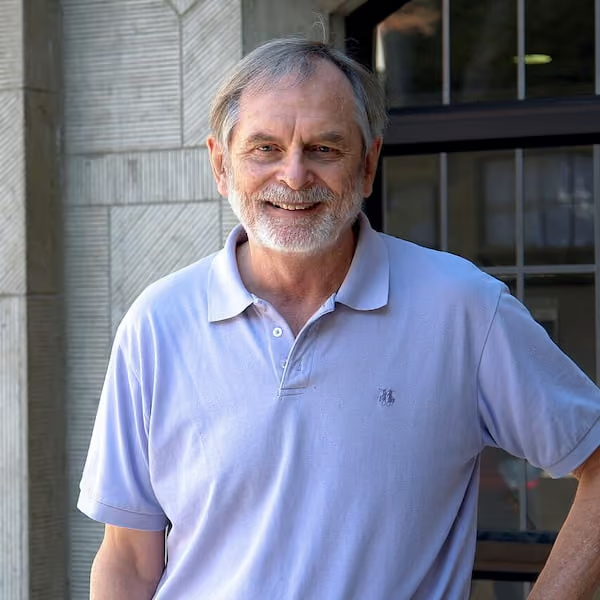
Victoria Wolf · Wikimedia Commons · CC BY-SA 4.0
Few figures embody so well the conviction that frontier science can be done from Chile without asking permission. Schmidt chose to come home after earning his doctorate at Stanford, to stay, to train people, to build community, and, from UTFSM (the Federico Santa María technical university in Valparaíso), to connect Valparaíso with the great international nodes of high-energy physics.
As his student Claudio Dib said of him, he brought "not only knowledge of an unbeatable and fascinating logical rigour, but also a vision of what needed to be done differently from what was already being done", translated from Spanish.
A boy from San Javier in the best schools in the world
Schmidt left the Colegio San Francisco Javier in Puerto Montt with the class of 1962. In 1963 he entered UTFSM and graduated in 1968 as an Electronic Civil Engineer. His talent opened doors abroad: the OAS awarded him a scholarship to the United States, where he passed through two of the great cathedrals of twentieth-century theoretical physics.
Electronic Civil Engineer
UTFSM, Valparaíso.
Master's degree in Physics
University of Pittsburgh, United States.
PhD in Physics
Stanford University, United States.
Traces of a 78-year career
A life ordered by discoveries, institutions founded and students trained. Every milestone in the left-hand column is also a mark on the history of Chilean science.
Born in Puerto Montt
Born on 12 April in Puerto Montt, Chile.
Leaves the Colegio San Francisco Javier
Finishes secondary school in Puerto Montt as part of the class of 1962.
Electronic Civil Engineer, UTFSM
Graduates from the Universidad Técnica Federico Santa María after enrolling in 1963.
Joins the UTFSM academic staff
Begins his 51-year career in the Department of Physics.
Master's degree in Physics, Pittsburgh
On an OAS scholarship, earns his master's degree at the University of Pittsburgh.
PhD in Physics, Stanford
A doctorate from one of the most prestigious institutions in the world for theoretical physics.
Full-time professor and head of department
Becomes a full-time professor and creates the undergraduate and master's programmes in Physics. He will head the department for three terms: 80–82, 86–88 and 96–98.
Predicts symmetry breaking in QCD
A pioneering study anticipating the breaking of P, CP and T symmetries in high-energy nuclear collisions.
Latin American Meeting on High Energy Physics
Organises the meeting in Valparaíso, establishing Chile as a regional node.
Creates the UTFSM PhD in Physics
The university's first doctoral programme in physics, key to training Chilean researchers.
Theory and observation of antihydrogen
With Brodsky and Munger, proposes a method for producing relativistic antihydrogen. In 1995 CERN obtains the first 11 atoms using that technique.
Chile–CERN agreement
The chief promoter of the agreement signed by President Bachelet in Geneva. Chile joins the ATLAS experiment at the LHC.
Founds CCTVal
Creates the Centro Científico Tecnológico de Valparaíso (Valparaíso Scientific and Technological Centre), which he will direct for roughly a decade.
Professor Emeritus at UTFSM
Receives his university's highest academic honour. That same year, CERN discovers the Higgs boson with Chilean participation.
Experimental confirmation at ALICE
CERN's ALICE collaboration confirms with the LHC the 1984 prediction on symmetry breaking in QCD.
Nominated for the Premio Nacional de Ciencias Exactas
Recognition for the body of work of a lifetime, Chile's national prize for the exact sciences.
Death
Dies on 27 November, aged 78. He is survived by his wife María Teresa Riquelme and his children Eleni, Alan and Dania.
What he left behind in physics
Behind the numbers are four lines of research where his work broke new ground.
Theoretical production of antimatter
Together with Stanley J. Brodsky (Stanford) and Charles Munger, he proposed a method for producing relativistic antihydrogen atoms in accelerators. In 1995 CERN confirmed the theory by obtaining the first 11 antihydrogen atoms in history, opening the field of experimental antimatter research.
Breaking of P, CP and T symmetries in QCD
He was the first to predict the breaking of these fundamental symmetries as a result of a phase transition to a quark-gluon plasma in high-energy nuclear collisions. The hypothesis received evidence in 2009 (STAR, Brookhaven) and was confirmed in 2013 (ALICE, CERN).
Beyond the Standard Model
Theoretical work on the great open questions of modern physics: the origin of matter, neutrino collisions, the nature of dark matter and the existence of extra dimensions. Areas where the Standard Model still has no complete answers.
Nuclear structure and AdS/QCD duality
Contributions on nuclear antishadowing in deep inelastic neutrino scattering, and work on hadronic structure within the framework of quantum holography (soft-wall and light-front models).
The day Chile joined CERN
In June 2007, President Michelle Bachelet signed the collaboration agreement between Chile and CERN in Geneva. Behind that signature lay years of work by Professor Schmidt, who saw clearly what many others had not yet grasped: that a country like Chile could not only observe high-energy physics, but take part in it.
Two years later, in 2009, he founded the Centro Científico Tecnológico de Valparaíso (CCTVal), a UTFSM core centre that he directed for a decade. Under his leadership, CCTVal became the first Latin American collaborator to contribute physical parts to a CERN detector: muon detectors for ATLAS's "Small Wheel", a technology that only five countries in the world produce: China, Israel, Canada, Russia and Chile.
- CERN — Geneva, Switzerland
- Jefferson Lab — Virginia, United States
- Fermilab — Illinois, United States
- Brookhaven National Lab — New York, United States
- INFN — Italy
A philosophy without pretence
I always think I'm just getting started, and they tell me it's been 50 years, and I can't believe it. I still have interesting things left to do; people should be able to do what they love, and on top of that they pay me.
Iván Schmidt, interview for his 50th anniversary at UTFSM, translated from Spanish
Distinctions received
A chronological reading of how the Chilean and international scientific community recognised, prize after prize, an entire career.
What remains in Chilean science
CCTVal's director, William Brooks, remembered him as "an outstanding theoretical physicist, a national and international reference in the discipline, a productive researcher, a pioneer and driver of the field of particle physics in Chile, but alongside that a trainer of people and a driver of great projects", translated from Spanish. His contributions fall, in hindsight, into four great chapters.
- A pioneer of theoretical particle physics in Chile: he founded the theoretical and experimental particle physics groups at UTFSM and created the undergraduate (1980), master's and PhD (1991) programmes in Physics.
- Founder and director for more than a decade of the Centro Científico Tecnológico de Valparaíso (CCTVal), the core centre that articulated Chile's presence at CERN, Jefferson Lab, Fermilab, Brookhaven and INFN.
- The driving force behind Chile's entry into the ATLAS experiment at the LHC: the chief promoter of the Chile–CERN agreement signed in 2007, which allowed Chilean scientists to take part in the discovery of the Higgs boson in 2012.
- Extraordinary scientific output: more than 300 papers, ~7,000 citations, an h-index of 50. His work theoretically predicted the production of antihydrogen (confirmed at CERN in 1995) and the breaking of P, CP and T symmetries in QCD (with experimental evidence confirmed in 2013 by ALICE).
- UTFSM — Homenaje al Dr. Iván Schmidt Andrade. Universidad Técnica Federico Santa María
View source → - CCTVal — Homenaje póstumo al profesor Schmidt. Centro Científico Tecnológico de Valparaíso
View source → - CCTVal — Nominación al Premio Nacional 2022. Información oficial sobre la nominación al Premio Nacional
View source → - Wikipedia — Ivan Schmidt Andrade. Entrada enciclopédica con datos biográficos generales
View source → - Colegio San Francisco Javier — Sanjavierino que ilumina la ciencia. Reseña desde su colegio en Puerto Montt
View source → - Instituto Milenio SAPHIR — En memoria del Dr. Schmidt. Recuerdo desde la comunidad de física chilena
View source → - Depto. de Física USM — "Todavía tengo mucho por hacer". Entrevista por sus 50 años de trayectoria
View source →
How to cite
This is free to reuse under CC BY 4.0, as long as you give credit.
FísicaEterna. (2026). Iván Eugenio Schmidt Andrade — biography, FísicaEterna. Retrieved [access date] from https://www.fisicaeterna.cl/en/biographies/ivan-schmidt
@misc{fisicaeterna_ivan_schmidt,
  author  = {FísicaEterna},
  title   = {Iván Eugenio Schmidt Andrade — biography, FísicaEterna},
  year    = {2026},
  url     = {https://www.fisicaeterna.cl/en/biographies/ivan-schmidt},
  note    = {CC BY 4.0}
}