José María Maza Sancho
He measured supernovae from Cerro Tololo for years, and that catalogue ended up being one of the pieces used to discover that the expansion of the universe is accelerating.
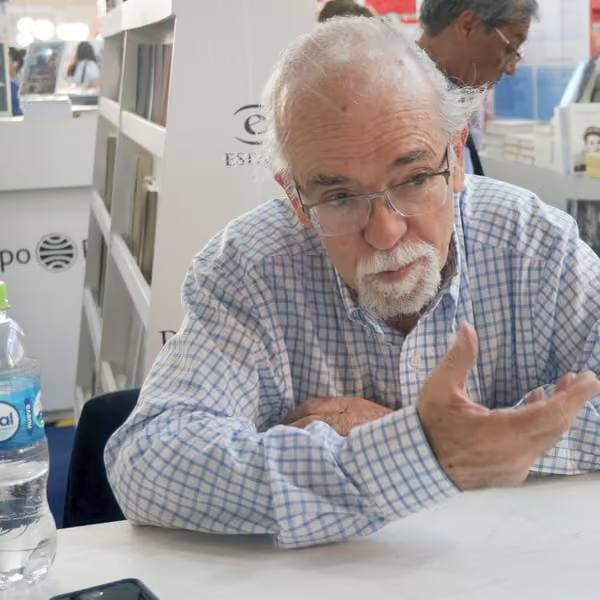
Rodrigo Fernández · Wikimedia Commons · CC BY-SA 4.0
A type Ia supernova is a star that always explodes with, more or less, the same brightness. That turns it into a ruler: if you know how much light it emitted and you measure how much reaches you, you know how far away it is. The problem was that "more or less" was too imprecise to measure anything.
Between 1990 and 1993, a Chilean team set out to fix that. José Maza was part of that team. What they did was patient and far from spectacular — observing supernovae from Cerro Tololo and calibrating them one by one — and it ended up being one of the foundations of the discovery that the universe is expanding ever faster.
From Valparaíso to the Internado Barros Arana, and from engineering to the stars
He was born in Valparaíso in 1948. "I came to the Internado Nacional Barros Arana in 1959," he said in an interview. In 1964 he entered the School of Engineering of the Universidad de Chile, and in 1966 he took his first astronomy courses; he ended up combining electrical engineering and astronomy.
He obtained his Master's degree in 1975 and his Doctorate in 1979, both with a specialisation in Astrophysics, at the University of Toronto. In 1987 he was appointed full professor at the Universidad de Chile, in 1995 he received a Cátedra Presidencial en Ciencias (Presidential Chair in Science), and between 1997 and 2000 he headed the Astronomy Department of the Faculty of Physical and Mathematical Sciences.
Born in Valparaíso
Internado Nacional Barros Arana
He moves to Santiago.
School of Engineering of the Universidad de Chile
First astronomy courses
Master's in Astrophysics
University of Toronto, Canada.
Doctorate in Astrophysics
University of Toronto, Canada.
Full professor at the Universidad de Chile
Calán/Tololo project
Calibration of type Ia supernovae, together with Mario Hamuy.
Cátedra Presidencial en Ciencias (Presidential Chair in Science)
Head of the Astronomy Department
Faculty of Physical and Mathematical Sciences.
Premio Nacional de Ciencias Exactas (Chile's national prize for the exact sciences)
The slow work that underpinned an enormous discovery
The Calán/Tololo project brought together the Astronomy Department of the Universidad de Chile — at Cerro Calán — with the Cerro Tololo observatory. Its goal was to measure nearby type Ia supernovae with enough precision to turn them into a reliable distance tool.
That dataset was key to the 1998 discovery that the expansion of the universe is accelerating, and with it, the existence of a dark energy component making up around 70% of all the energy in the universe. The Royal Swedish Academy of Sciences recognised it as part of the scientific background of the 2011 Nobel Prize in Physics.
How the country knows him
For much of Chile, Maza is not the co-author of a supernova catalogue but the man who fills theatres explaining the Big Bang. His popular-science books and talks turned him into an unusual kind of public figure: a Premio Nacional laureate who is genuinely committed to helping people understand.
I am the son of Gagarin and Valentina Tereshkova. They are my putative parents.
José Maza, on what pushed him towards astronomy, translated from Spanish
What the sources do not quite settle
He was born in Valparaíso in 1948, earned his doctorate in Astrophysics at the University of Toronto in 1979, and received the Premio Nacional de Ciencias Exactas in 1999.
The Universidad de Chile's Premios Nacionales profile, the Sociedad Chilena de Astronomía (Chilean Astronomical Society) and the ANID researchers' portal agree.
He was born on 18 January 1948.
The exact date appears only in Wikipedia. Neither the Universidad de Chile nor SOCHIAS publishes the day and month: both give only the year. That is why this page's entry records only 1948.
He has been a full professor at the Universidad de Chile since 1968.
That is what his ANID portal profile records. The Universidad de Chile's own profile says he was appointed full professor in 1987. ANID probably counts from his initial link to the university rather than from the appointment, but the sources do not clarify this.
The discovery of the acceleration of the universe took place in 1988.
That is what the Universidad de Chile's Premios Nacionales profile says, almost certainly through a typing error. All other sources — including those of the Calán/Tololo project itself, which ran between 1990 and 1993 — place the discovery in 1998, which is the date used here.
- Universidad de Chile. Perfil oficial de Premios Nacionales
View source → - Sociedad Chilena de Astronomía (SOCHIAS). Anuncio del Premio Nacional de Ciencias Exactas 1999
View source → - ANID · Portal de investigadores. Ficha con formación y líneas de investigación
View source → - El Mostrador (2022). Entrevista: infancia, formación y divulgación
View source →
How to cite
This is free to reuse under CC BY 4.0, as long as you give credit.
FísicaEterna. (2026). José María Maza Sancho — biography, FísicaEterna. Retrieved [access date] from https://www.fisicaeterna.cl/en/biographies/jose-maza
@misc{fisicaeterna_jose_maza,
  author  = {FísicaEterna},
  title   = {José María Maza Sancho — biography, FísicaEterna},
  year    = {2026},
  url     = {https://www.fisicaeterna.cl/en/biographies/jose-maza},
  note    = {CC BY 4.0}
}