María Teresa Ruiz González
Chilean astronomer, discoverer of Kelu-1 and the first woman to receive the National Prize for Exact Sciences.
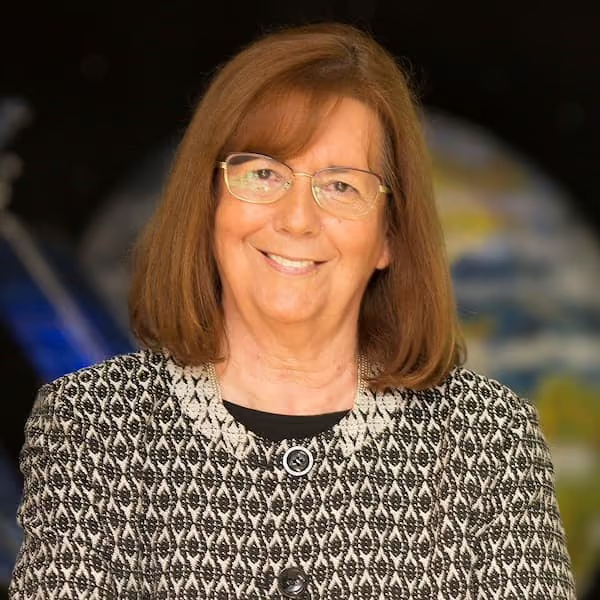
Comunicaciones CONICYT · Wikimedia Commons, 2018 · CC0 · Dominio público
María Teresa Ruiz González was born in Santiago in 1946 and grew up with a conviction her grandmother, Teresa Matthews, repeated to her as a teenager: being a woman could not be an obstacle to living a big life.
That idea became a whole career. Ruiz was the first woman to earn a degree in Astronomy in Chile, one of the first Chilean women to take a doctorate in Astrophysics at Princeton, the first woman to receive the Premio Nacional de Ciencias Exactas (Chile's national prize for the exact sciences), and the first woman to preside over the Academia Chilena de Ciencias (the Chilean Academy of Sciences).
Her biography reads like a sequence of milestones, but underneath that list is something more interesting: a scientist who chose to look at almost invisible objects — cold, faint, borderline stars — and from there helped widen our idea of the universe.
Teresa Matthews was a decisive presence. When Ruiz was 14 she went to live with her to keep her company through an illness. That free-thinking, feminist-minded grandmother planted an idea that would run through her whole career: no girl should shrink her ambitions for the mere fact of being a woman.
From public education to Princeton
Ruiz has proudly described herself as a daughter of Chilean public education. She studied at the Liceo 7 de Niñas in Santiago, began her university path in Chemical Engineering at the Universidad de Chile, and then found her natural language in astronomy.
In 1971 she obtained her degree in Astronomy from the Universidad de Chile and the Carnegie-Chile Fellowship to continue her studies in the United States. At Princeton she completed her master's in Astrophysics in 1973 and her doctorate in 1975, building a scientific base she would later put to use across Chile, Italy, Mexico and the United States.
Her time at Princeton was not just an academic credential. She was part of a generation of women scientists who had to establish a presence in spaces where there were almost no Latin American women. From there she returned to Chile with an international training she would put to the service of research, teaching and institution-building.
A dark night, with no Moon, when the stars looked spectacular from the mountain, at Cerro Tololo... that is when I knew this was mine.
María Teresa Ruiz, on her calling to astronomy, translated from Spanish
Italy, Mexico, NASA and the return to Chile
After completing her doctorate, Ruiz carried out postdoctoral research at the Astronomical Observatory of Trieste, Italy, where she deepened her work on the final stages of stellar evolution. She then worked as a visiting astronomer at the Institute of Astronomy of UNAM (Mexico's national autonomous university) and, in 1978, as a visiting scientist at NASA's Goddard Institute for Space Studies in New York.
That international path was key to her scientific maturity. When she joined the Universidad de Chile in full, she brought with her not only observation and research techniques, but a network of experience that helped project Chilean astronomy into a global conversation.
The faint objects that changed the map
Her research focused on low-mass stars, brown dwarfs and the final stages of stellar evolution. Rather than chasing only the spectacular, Ruiz sharpened her eye to detect faint, difficult bodies — the kind that force a careful distinction between planet, star and something in between.
Kelu-1
Discovered in 1997 in the constellation Hydra, about 61 light years from Earth. In Mapuche, "kelu" means red. The object turned out to be a system of two brown dwarfs orbiting each other, and it became a milestone in the observational confirmation of substellar bodies.
A supernova caught exploding
She observed a supernova at the precise moment it exploded, an exceptionally rare event that provides crucial information about the death of massive stars.
Nebulae in the galactic halo
She identified two planetary nebulae in the Milky Way's halo, contributing data on the formation, evolution and structure of our galaxy.
The origin of brown dwarfs
Before retiring, she collaborated on projects linked to ALMA (the Atacama Large Millimeter/submillimeter Array) to study whether brown dwarfs form like planets or as small clumps of matter that collapse on their own.
Kelu-1 was named with a Mapuche word for red, a fitting choice for a cold, faint and decisive object. Its discovery confirmed that the universe is full of bodies that do not fit comfortably into our initial categories.
The discovery was made at La Silla Observatory and became one of the first strong confirmations of free-floating brown dwarfs. These objects are neither ordinary planets nor full stars: they have intermediate masses and cannot sustain hydrogen fusion the way a stable star does.
A half-century-long career
Born in Santiago
Born on 24 September in Santiago, Chile.
Liceo 7 de Niñas and public education
She is educated in the Chilean public school system, a stage she would champion throughout her life.
Chile's first woman graduate in Astronomy
She obtains her degree in Astronomy from the Universidad de Chile and receives the Carnegie-Chile Fellowship.
Master's at Princeton
She completes her M.Sc. in Astrophysics at Princeton University.
Doctorate in Astrophysics
She earns her Ph.D. at Princeton, opening a path for Chilean women scientists in international astronomy.
Postdoctorate in Trieste
She carries out postdoctoral research at the Astronomical Observatory of Trieste, Italy, specialising in the final stages of stellar evolution.
Visiting astronomer at UNAM
She works at the Institute of Astronomy of Mexico's National Autonomous University.
Visiting scientist at NASA Goddard
She joins the Goddard Institute for Space Studies in New York, broadening her international experience.
Professor at the Universidad de Chile
She begins a lengthy teaching career in the Astronomy Department of the Faculty of Physical and Mathematical Sciences.
Kelu-1 and the Premio Nacional
She discovers Kelu-1 at La Silla Observatory and receives the Premio Nacional de Ciencias Exactas, the first woman to obtain it.
Head of the Astronomy Department
She takes charge of the Astronomy Department at the Universidad de Chile, a post she holds until 2005.
First woman to preside over the Academia Chilena de Ciencias
She is elected unanimously as the first woman to chair the institution, a post she holds until 2018.
L'Oréal-UNESCO For Women in Science award
She receives this international recognition in Paris for her contributions to the study of brown dwarfs and low-luminosity stars.
France's Legion of Honour
She is made a Chevalier (Knight) of the Legion of Honour, the highest decoration of the French Republic.
Retirement after more than 50 years
She announces her retirement from teaching and active research due to an eye condition that had progressively affected her sight.
Looking at the sky is also something you teach
From 1987 she carried out extensive academic work at the Universidad de Chile, training generations of astronomers. Her courses covered modern physics, general astronomy, intelligent life in the universe, extragalactic astronomy, gaseous nebulae and stellar populations.
- Modern Physics
- General Astronomy
- Intelligent Life in the Universe
- Extragalactic Astronomy
- Gaseous Nebulae
- Stellar Populations
She also chaired and drove key spaces for the development of national astronomy, including the Fundación para el Desarrollo de la Astronomía de Chile (the Foundation for the Development of Astronomy in Chile) and the Centro de Astrofísica y Tecnologías Afines (the Centre for Astrophysics and Related Technologies). Her work helped establish Chile as a country that not only hosts telescopes, but produces knowledge from them.
Fundación para el Desarrollo de la Astronomía de Chile
She chaired and drove initiatives aimed at strengthening national astronomy.
Centro de Astrofísica y Tecnologías Afines
She contributed to the institutional development of CATA and to the links between research, technology and outreach.
Astronomy Department, Universidad de Chile
She served as head between 2001 and 2005, during a key stage in the field's consolidation.
Academia Chilena de Ciencias
The first woman to chair it, elected unanimously by the members present.
Hijos de las estrellas
A journey through the history of the universe, from the Big Bang to the formation of Earth and the origin of life.
Desde Chile, un cielo estrellado
An invitation to explore the Chilean night sky, with guides to constellations, planets and objects visible from the southern hemisphere.
El Sol: Conviviendo con una estrella
Written during the pandemic and despite a severe eye condition, it shows her tenacity and her commitment to bringing astronomy to everyone.
Her dream, repeated in interviews and outreach writing, was for science to find evidence of life beyond Earth. For Ruiz, the universe remained an open conversation: full of bodies invisible to the human eye, questions not yet asked, and worlds we may not yet know how to recognise.
Awards from an exceptional career
The report also places her among the most influential women in Chile, not only for her discoveries, but for the way she opened up spaces of scientific authority for other women.
Her retirement in 2025, prompted by an eye condition that had progressively affected her sight, closed a chapter of active research, but not her influence. Every generation she trained, every outreach book, and every public conversation about Chilean astronomy carries part of that legacy.
María Teresa Ruiz made a faint part of the cosmos visible and, at the same time, made a possibility visible for generations of Chilean women scientists.
María Teresa Ruiz González · Santiago, 1946, translated from Spanish
- Universidad de Chile — Perfil académico. Trayectoria universitaria, premios y vínculo con el Departamento de Astronomía.
View source → - Academia Chilena de Ciencias. Presidencia de María Teresa Ruiz y reconocimientos institucionales.
View source → - L'Oréal-UNESCO For Women in Science. Reconocimiento internacional recibido en 2017 por sus aportes a la astronomía.
View source → - NASA ADS — Publicaciones científicas. Índice bibliográfico de trabajos astronómicos y artículos de investigación.
View source →
How to cite
This is free to reuse under CC BY 4.0, as long as you give credit.
FísicaEterna. (2026). María Teresa Ruiz González — biography, FísicaEterna. Retrieved [access date] from https://www.fisicaeterna.cl/en/biographies/maria-teresa-ruiz
@misc{fisicaeterna_maria_teresa_ruiz,
  author  = {FísicaEterna},
  title   = {María Teresa Ruiz González — biography, FísicaEterna},
  year    = {2026},
  url     = {https://www.fisicaeterna.cl/en/biographies/maria-teresa-ruiz},
  note    = {CC BY 4.0}
}