Mario Hamuy Wackenhut
He was principal investigator of the project that turned supernovae into a ruler for measuring the universe. He then put the telescope aside for a while to write the law that created the Ministry of Science.
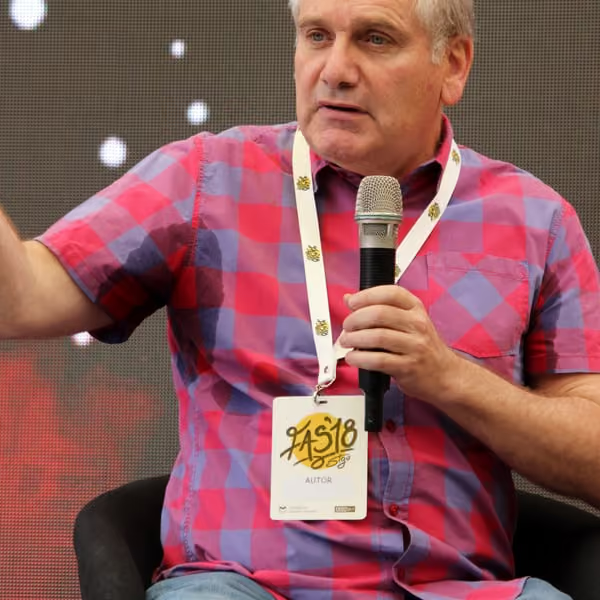
Rodrigo Fernández · Wikimedia Commons · CC BY-SA 4.0
There is a way of doing science that gives no interviews: measuring well. Between 1990 and 1993, Mario Hamuy was principal investigator of the Calán/Tololo project, dedicated to observing type Ia supernovae and calibrating them until they became a reliable ruler for measuring cosmic distances.
That dataset was one of the pieces with which, in 1998, it was discovered that the universe is expanding ever faster. Twenty years later, Hamuy was somewhere else entirely: chairing CONICYT (Chile's national commission for scientific and technological research) and pushing the bill that created the Ministerio de Ciencia.
Supernovae as a measuring ruler
He enrolled at sixteen to study for a Licenciatura in Physics at the Faculty of Physical and Mathematical Sciences of the Universidad de Chile, followed by a master's degree in 1984, and earned his doctorate in Astronomy at the University of Arizona. His research areas are novae and supernovae, globular clusters, active galaxies and cosmology.
He was principal investigator of the Calán/Tololo project between 1990 and 1993, together with José Maza. The team delivered the dataset and the technique that, in 1998, made it possible to establish the acceleration of the expansion of the universe and the existence of a dark energy component making up around 70% of all the energy in the cosmos.
Born in Santiago
On 25 March.
Licenciatura in Physics
Faculty of Physical and Mathematical Sciences, Universidad de Chile. He enrolled at 16.
Master's degree
At the same university.
Calán/Tololo project
Principal investigator. Calibration of type Ia supernovae.
Ph.D. in Astronomy
University of Arizona, United States.
Full professor at the Universidad de Chile
That same year he received the Guggenheim fellowship.
Director of the Instituto Milenio de Astrofísica (MAS)
Premio Nacional de Ciencias Exactas (Chile's national prize for the exact sciences)
Chair of CONICYT
And science advisor to the Presidency of the Republic.
AURA
Vice president and head of mission for the association's observatories.
What "having contributed" means
The 2011 Nobel Prize in Physics went to Saul Perlmutter, Adam Riess and Brian Schmidt. Chilean institutional profiles describe Hamuy as "one of the architects of the technique — and of obtaining the dataset — that made" that result possible.
It is a careful formulation, and one worth not stretching. The Chilean team did not discover the acceleration: it built the tool and the catalogue without which the discovery would not have been possible. In a discipline where the prize goes to whoever arrives last, that distinction matters — and it says something about how credit is distributed in international science.
When he left the telescope to write a law
He took over as chair of CONICYT on 16 October 2016 and left the post on 31 October 2018. During that period he was also science advisor to the Presidency of the Republic and led the bill that created the Ministerio de Ciencia, Tecnología, Conocimiento e Innovación (Ministry of Science, Technology, Knowledge and Innovation).
It is an unusual move: crossing from a field where merit is measured in publications to one measured in legislative procedures, and back again. When announcing his Premio Nacional in 2015, Education Minister Adriana Delpiano highlighted "the worldwide impact of his work in astronomy in the field of supernovae, in particular the precise measurement of the rate of expansion of the universe".
What the sources do not quite settle
He was principal investigator of the Calán/Tololo project between 1990 and 1993, and received the Premio Nacional de Ciencias Exactas in 2015.
The Universidad de Chile, CONICYT, the Biblioteca del Congreso Nacional (National Congress Library) and the Instituto Milenio de Astrofísica agree.
He was born on 25 March 1960.
The Universidad de Chile and Wikipedia agree on 25 March. Wikidata records 25 May. March is used because it is the figure given by the institutional source, but the discrepancy over the month remains open.
His 1984 master's degree was in Physics.
The Universidad de Chile and CONICYT say Physics; the Instituto Milenio de Astrofísica profile and a note from the Biblioteca del Congreso say Astronomy. Three institutional sources, two different answers.
He obtained his Licenciatura in Physics in 1982.
That is what the Universidad de Chile says; Wikipedia records 1983.
- Universidad de Chile. Perfil oficial de Premios Nacionales
View source → - CONICYT (2015). Anuncio del Premio Nacional de Ciencias Exactas 2015
View source → - CONICYT (2016). TWAS Prize en Ciencias de la Tierra, el Espacio y Astronomía
View source → - Instituto Milenio de Astrofísica (MAS). Perfil de investigador
View source →
How to cite
This is free to reuse under CC BY 4.0, as long as you give credit.
FísicaEterna. (2026). Mario Hamuy Wackenhut — biography, FísicaEterna. Retrieved [access date] from https://www.fisicaeterna.cl/en/biographies/mario-hamuy
@misc{fisicaeterna_mario_hamuy,
  author  = {FísicaEterna},
  title   = {Mario Hamuy Wackenhut — biography, FísicaEterna},
  year    = {2026},
  url     = {https://www.fisicaeterna.cl/en/biographies/mario-hamuy},
  note    = {CC BY 4.0}
}