Rodulfo Amando Philippi Krumwilda
He directed the National Museum of Natural History for more than four decades and taught natural sciences in Chile, for the first time, by observing first and concluding afterwards.
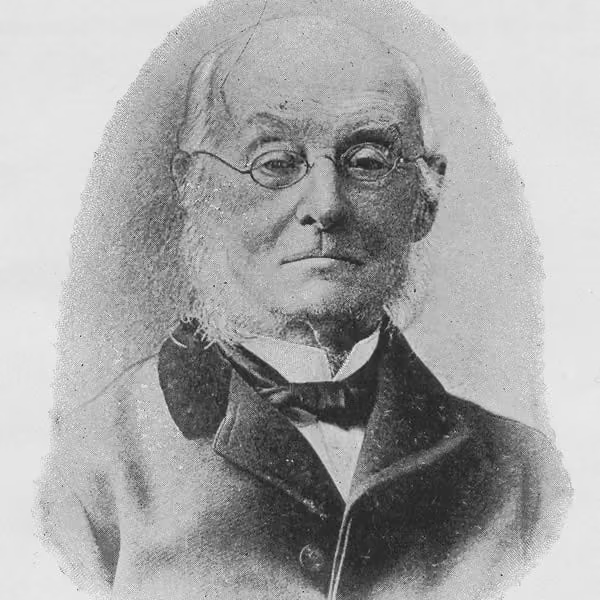
Autor no identificado, c. 1895 · Wikimedia Commons · Dominio público
As a child, Rodulfo Amando Philippi was sent to a Swiss school where nothing was learned by rote: it was learned by looking. It was the establishment run by Johann Heinrich Pestalozzi, in Yverdon, and there a young German boy picked up the habit that would later change the face of science teaching in Chile —observing the fact before forming an opinion about it—.
Seventy years later, when he turned ninety, Chile's political and academic world gave him a tribute in his own lifetime. He had spent four decades directing the Museo Nacional de Historia Natural.
From Yverdon to Berlin
He was born on 14 September 1808 in Charlottenburg, near Berlin. The family moved to the Swiss town of Yverdon, where he and his brother Bernardo Eunom attended Pestalozzi's experimental school. Afterwards their paths diverged: Rodulfo Amando went on to study medicine at the University of Berlin; Bernardo Eunom took the military path.
His studies did not stop at medicine. They included surgery, comparative anatomy, botany and zoology: the full repertoire of a 19th-century naturalist.
The 1853 call
By 1853 Philippi was already settled in Valdivia and ran the city's Liceo. That year he received an invitation from the government to teach Natural History, and was appointed director of the Museo Nacional de Historia Natural —the institution that had been born as Claudio Gay's Gabinete de Historia Natural—.
He stayed more than four decades. He put the old and new collections in order, categorised them, catalogued them and classified them logically: he turned an accumulation into a museum. He was also a professor of Botany and Zoology, and of Natural Sciences at the Instituto Nacional.
Born in Charlottenburg
Near Berlin, then part of Prussia.
Pestalozzi's school
In Yverdon, Switzerland: an education based on the direct observation of reality.
Graduates in Berlin
Medicine, with studies also in surgery, comparative anatomy, botany and zoology.
Valdivia and the call
He was running the Liceo de Valdivia when the government invites him to Santiago; he is appointed director of the Museo Nacional de Historia Natural.
The Atacama expedition
Decree from the Ministerio de Hacienda (Treasury Ministry) in November 1853. Four pesos a day and an extra sum to put together his equipment.
Journey to the Atacama Desert
The definitive text is published first in Germany and then in Chile: nine chapters divided into four parts.
Honorary doctorate
Awarded by the University of Berlin.
Tribute at ninety
Chile's political, scientific, educational and cultural world honours him in his lifetime.
Dies in Santiago
On 23 July, at home, aged 95.
A scientific expedition that ended up as a border argument
The government commissioned him to travel the north to gather information on mineral resources, and along the way to complete his research into terrestrial and marine flora and fauna and to collect fossils and archaeological objects. He brought Guillermo Döll onto the team, with whom he had already travelled through the province of Valdivia.
He went from south to north: from Chañaral to Las Ánimas along the coast, passing through Pan de Azúcar and the nitrate deposits inland from the port of Taltal. The book that came out of it, published in 1860, was used for teaching —but also, Memoria Chilena notes, as a diplomatic tool that allowed Chile to put forward a definition of its political borders.
The teacher
His word is heard with respect; his lessons, based on the logical unfolding of natural phenomena and on the strict observation of facts, free of sectarian concerns or departures from a positively scientific outlook, awaken understanding and inspire young people.
Adolfo Murillo, in the 1898 tribute, translated from Spanish
He was the first in our country to teach those sciences in a truly scientific way.
Diego Barros Arana, posthumous text, translated from Spanish
The two statements say the same thing from different angles, and both point to method before findings. What his contemporaries highlighted about Philippi was not how many species he described —and there were very many— but that he taught people to look first.
- More than forty years directing the Museo Nacional de Historia Natural.
- More than 400 scientific publications, according to the Fundación Philippi.
- The first science-teaching text in Chile based on native species, rather than European examples.
- He researched in botany, zoology, palaeontology and anthropology, including ethnographic studies of indigenous peoples.
What the sources do not quite settle
He was born on 14 September 1808 in Charlottenburg and died on 23 July 1904 at his home in Santiago.
Memoria Chilena gives both dates; the Fundación Philippi agrees on the birth date.
He died aged 95.
The Fundación Philippi says 96, but the arithmetic contradicts it: born on 14 September, in July 1904 he had not yet had his birthday. The English Wikipedia also records 95.
He described more than 2,500 new mollusc taxa and more than 425 new species of flies.
The figures appear in the English Wikipedia and we could not confirm them in an institutional source. What does appear in a source of its own —the Fundación Philippi— is the figure of more than 400 scientific publications.
He was the one who received the museum "created by Claudio Gay".
That is how the Fundación Philippi puts it. Memoria Chilena is more careful: it says Gay founded the Gabinete de Historia Natural and its library, "now" the Museo Nacional de Historia Natural. The two versions are compatible, but they do not say exactly the same thing about institutional continuity.
- Memoria Chilena · Biblioteca Nacional de Chile. Rodulfo Amando Philippi Krumwilda (1808-1904): presentación
View source → - Memoria Chilena · Biblioteca Nacional de Chile. El naturalista alemán a la cabeza del Museo
View source → - Memoria Chilena · Biblioteca Nacional de Chile. La expedición al desierto de Atacama (1853-1854)
View source → - Memoria Chilena · Biblioteca Nacional de Chile. Homenajes para Rodulfo Amando Philippi: discursos de 1898 y semblanza de Barros Arana
View source → - Fundación Philippi. Perfil de la fundación dedicada a su legado
View source → - Wikipedia (inglés). Origen de las cifras de taxones descritos y del doctorado honoris causa de 1890
View source →
How to cite
This is free to reuse under CC BY 4.0, as long as you give credit.
FísicaEterna. (2026). Rodulfo Amando Philippi Krumwilda — biography, FísicaEterna. Retrieved [access date] from https://www.fisicaeterna.cl/en/biographies/rodulfo-philippi
@misc{fisicaeterna_rodulfo_philippi,
  author  = {FísicaEterna},
  title   = {Rodulfo Amando Philippi Krumwilda — biography, FísicaEterna},
  year    = {2026},
  url     = {https://www.fisicaeterna.cl/en/biographies/rodulfo-philippi},
  note    = {CC BY 4.0}
}